

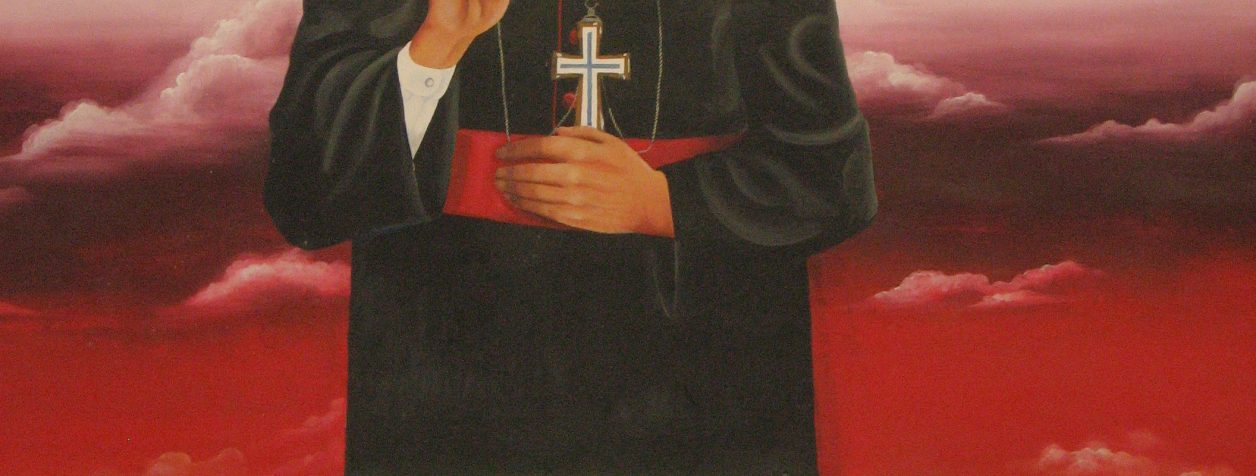
One of the defining features of our present moment is a deep and growing polarisation. What once felt like a shared social fabric – an interwoven tapestry of difference – now appears increasingly torn into distinct and often hostile fragments. Disagreement has become division. Those who hold opposing views are finding it harder not only to agree, but even to remain in meaningful relationship with one another.
In such a context, the question is not simply how we resolve disagreement, but whether communion is still possible at all.
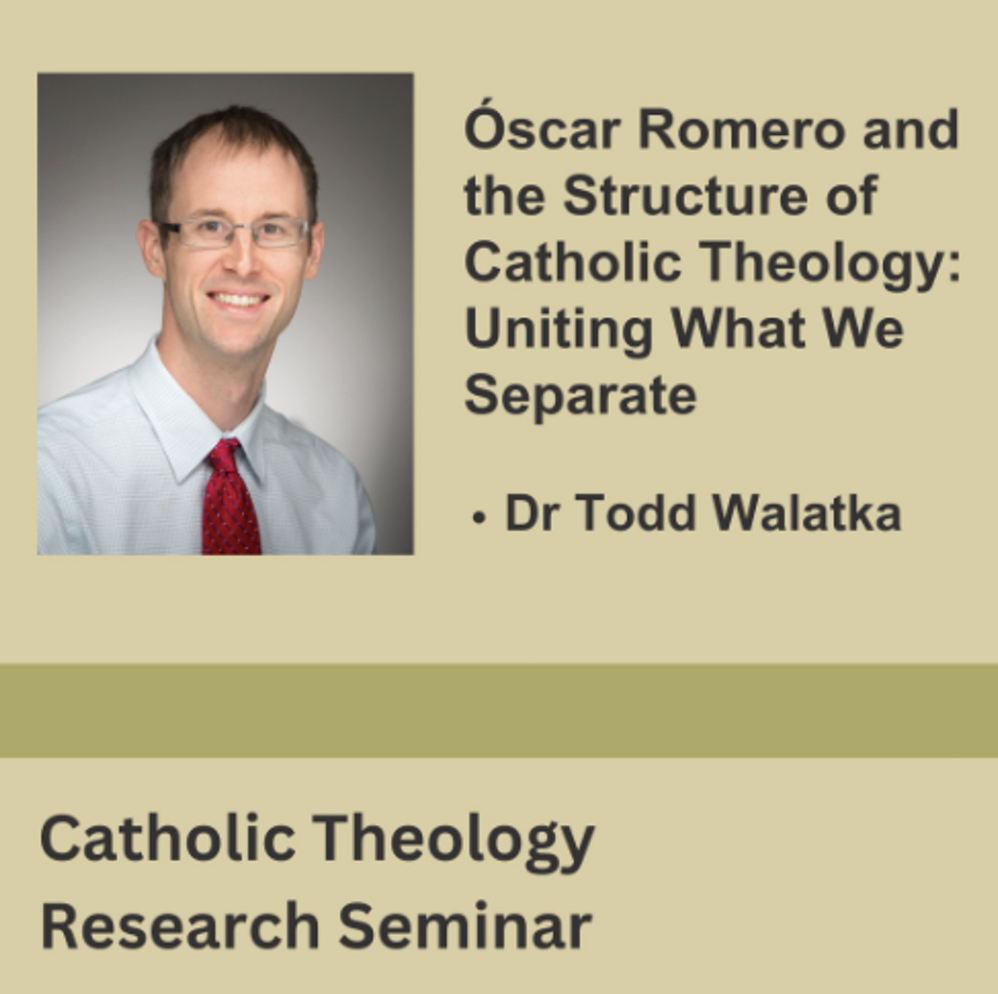
What struck me most in a recent seminar, led by Professor Todd Walatka and titled “Oscar Romero and the Structure of Catholic Theology: Uniting What we Divide” (accessible here), was the sense that Romero offers precisely here what we most lack: not a false harmony or easy consensus, but what might be called a complex communion. This is a vision of communion not rooted in the absence of disagreement, but in a sustained, often difficult tension between differing truths, held together in a way that is mutually enriching rather than mutually destructive.
Walatka proposed that Romero’s theology is best understood through the image of an ellipse rather than a circle. An ellipse has two foci, and every point is defined by its relation to both. Applied to theology, this suggests that Romero consistently holds together paired affirmations that are equally strong, deeply related, and yet irreducible to one another. This is not moderation, nor compromise, but something closer to maximalism: a refusal to dilute either pole.

Weisstein, Eric W. “Ellipse.” From MathWorld—A Wolfram Resource.
https://mathworld.wolfram.com/Ellipse.html
Yet Romero’s theology is not static. He does not simply sit between two truths in abstract balance. Rather, he moves dynamically within these tensions, responding to what the Church calls the signs of the times. In contexts of extreme violence and poverty, this sometimes meant placing greater emphasis on the historical and concrete dimensions of salvation – not to deny its transcendent character, but to correct an imbalance that risked rendering the Gospel disincarnate.
This is perhaps most clearly seen in Romero’s understanding of salvation itself. On the one hand, he insists that salvation is not to be confused with any political project. It is God’s work in Christ, oriented toward eternal life. On the other, he speaks with urgency about the need to “save the human person here and now”, to confront structural injustice, poverty, and violence in history. For Romero, the Kingdom of God is both already breaking into the world and not yet fulfilled beyond it.
This tension feels particularly relevant in the context of Catholic Social Teaching today. Too often, efforts that could be deeply enriched by a theological vision (such as advocacy on migration or poverty) risk being framed in purely political or cultural terms. What is lost in this framing is precisely what gives these efforts their deepest force: the conviction that this is not, at root, a culture war issue, but an ethical one. It concerns how we treat the vulnerable, the marginalised, and the neighbour. Without this spiritual and theological depth, social action risks losing its capacity to truly convict hearts and minds.

A similar dynamic appears in Romero’s understanding of the Church. His episcopal motto, sentir con la Iglesia (to think and feel with the Church) captures a profound double belonging. On the one hand, Romero is deeply attentive to the lived experience of the people, especially the poor. He listens, accompanies, and learns from them, recognising in their faith a genuine locus of theological insight – the sensus fidelium. On the other, he remains firmly rooted in the teaching of the Church, drawing constantly on Vatican II and the Latin American episcopal conferences.
This tension remains alive in the Church today, particularly in the context of the Synod on Synodality. There are signs that the Church is beginning to recover something of this balance, but there are also risks. One is that the listening process becomes a purely empirical exercise, rather than a genuine attempt to discern the voice of the Spirit speaking through the whole People of God. Another is that, in reacting against clericalism, we lose sight of the need for mercy and patience towards the humanity and fallibility of those in leadership. The sensus fidelium is not opposed to the magisterium, but is an expression of the communion of the whole Church, from laity to pope.
Romero’s thought also refuses to separate structural injustice from personal conversion. He speaks with clarity about “structures of sin,” recognising the ways in which economic, political, and cultural systems perpetuate violence and inequality. Yet he is equally insistent that these structures are rooted in the human heart. There can be no lasting transformation of society without a transformation of the persons who inhabit and sustain it. As Pope John Paul II would later emphasise, even structural sin has its origins in personal sin. For Romero, the call to conversion is therefore inescapable.
What emerges across these tensions is not a neat system, but a way of thinking and living that resists reduction. Romero refuses both spiritual escapism and political reductionism; both institutional rigidity and populist fragmentation; both moral individualism and structural determinism. In doing so, he offers not a comfortable middle ground, but a demanding form of both/and thinking that requires discernment, courage, and fidelity.
In an age increasingly captivated by the logic of “hard power” – by the appeal of strongmen, force, and domination- Romero points to a different kind of power altogether. It is the power of truth spoken with courage; of witness sustained in the face of violence; of a voice that refuses hatred even while naming injustice.

Ultimately, this is the power revealed in Christ himself: a power made perfect not in domination, but in self-giving love. A kenotic love.
If our world is to recover any sense of communion, it will not be by eliminating difference or silencing disagreement. It will be by learning, once again, how to hold tensions truthfully and faithfully—how to live within them without allowing them to tear us apart.
Romero shows us that this is not only possible. It is necessary.
This article was written by CSAN’s Communications and Programmes Officer, David Byrne. With thanks to Prof. Todd Walakta for his seminar, and Durham University’s Centre for Catholic Studies for hosting this event.


You must be logged in to post a comment.