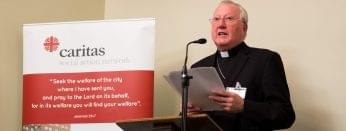


This reflection was written for Day 8 of our World Day of the Poor Novena, which is “For Young People who Experience Unemployment”. It was produced by Sir John Battle, Chair of the Leeds Diocesan Justice and Peace Commission and former MP for Leeds West.
Not before time, Britain seems to be waking up to the fact that in the UK young people are now the “new poor”.
A recent IPPR Report, entitled “The Loneliest Generation” spelt out that in the transition from youth to adulthood it is “much harder…to pass the milestones that previous generations achieved in work, housing and education“. The now constantly repeated fact that nearly one million young people between 16 and 25 years old in the UK are not in education, employment or training, prompted the Alan Milburn enquiry which has already warned that there is a risk of “a wasted generation” if the country doesn’t change course. In his interim report last May, he spelt out that Britain risked “a lost generation of young people” as the rise of mental health meant that most young people who are classed as these NEETS have never worked and were unlikely to find employment in their lifetime. Written off.
At least the Government’s Education Secretary has now acknowledged that “too many young people who fall out of education risk being permanently left on the sidelines of work and opportunity“.
Meanwhile, the Children’s Commissioner, Rachel de Souza in a recently published comprehensive report on the position of children in our UK communities, has warned that the nation “seemed blind” to the young generation and was “too quick to stereotype teenagers“. Presenting the report she said, “We’re either hearing that they are snowflakes who can’t cope or they’re running around with masks and hoodies on“. But, she added, “I don’t buy into the idea that this is some kind of weak generation. I’m seeing the opposite. I’m seeing kids in the toughest environment really working hard to try and build a life.” Notably last year more than 14,000 18-year-olds left full-time care. They too face insuperable challenges.
Most young people in our society today are faced with the challenges of getting appropriate education and training yet in doing so are overcharged and saddled with overwhelming debts for further and higher education. Many are often forced to live at home with parents or grandparents possibly until the age of 35. In practice, the future for the young in our society is daunting and that is before the accelerating impact of technologies such as AI and social media threatening increased manipulation, isolation and disruption. Little wonder that with apocalyptic rumours of AI potentially wiping out humanity in 10 years and as defence officials are advising the country to prepare for war in the next decade, young people are being increasingly driven towards hopelessness.
In the last twenty years the age range during which men are most at risk for suicide has dropped from 50-75 to 25-55. A recent opinion poll by More in Common spelt out that most young people believe that school leaves them least prepared for looking after their mental health (37%), understanding the world (36%) and coping with changes (29%).
We need to publicly ask, therefore, do young people therefore ever get a fair hearing or a look in?
Are they really listened to or are they generally written off?
At general election times, there used to be a tradition of getting all the different political party candidates together for a public question time, usually held in a church or school hall. All the candidates would be there at the top table to speak in turn about themselves and their policies and then be open to any questions from the audience who turned up. It was the general election hustings to be held in every parliamentary constituency. It has been my privilege to have represented the people of the constituency of Leeds West from 1987 (when I wasn’t when I was unexpectedly voted in the age of 36) and I vividly remember the hustings in my neighbourhood of Bramley during the General Election Campaign in March 1992. It was held in a church hall on a rainy night and about 60 to 70 people turned up to sit on the rows of chairs to listen and question their candidates. I was the Labour candidate, whilst candidates from the Liberal Democrats the Conservatives, the Greens and an independent were also present. We stated our case and faced questions on a variety of issues such as taxation, policing and crime, bus routes, and the state of the local ginnels. It was straightforward enough with no raucous arguments or violent dissenting. Most of the audience, however, were well into retirement age but with one notable exception at the back corner of the hall. There was one obvious young man present on his own who had not asked a question. So, as the session came to a close, I personally invited him to ask us any question or make a comment since whichever of us ended up elected could drastically affect his future. He stood up and paused and then said; “I’m a human being. What are you going to do about it if you get elected?“.
It was one of the best and most difficult questions ever put to me as a politician and one that has stayed with me. Politicians elected to Parliament spend most of their time discussing and voting on laws and budgets. Perhaps I’d simply been asked to think seriously before I went through any voting lobby and consider how my decision on that piece of legislation or budget would affect the life opportunities of that young man and to pause and recall that he was not a number or statistic but a real human being with potential before casting any of my votes.
And it applied to all: “I’m a human being. What are you as my representative doing about it in practice?” It remained a haunting question, and it forced me to ask myself how often did I actually vote with the crowd or the “party whipped line” or for an unthought through policy or simply to ensure local media publicity, without proper consideration of those people who would be affected.
Pope Leo’s recent public encyclical entitled “Magnifica Humanitas” stresses the wonderful “magnificence” of the human, God-created person. Catholic Social Teaching has a long tradition of spelling out that “each person is special and unique” and has something to contribute (“subsidiarity“) to the “Common Good” and that “no person should be left out” of this project (“solidarity“).
St Thomas Aquinas put it even stronger: “We should not despair of anyone in this life considering God’s almightiness and mercy“. We are not to judge.
The psychologist Jonathan Haidt has claimed that young people’s mental health has deteriorated because of their use of smart phones and social media which have helped to create “an anxious generation“. The head of the John Lewis partnership in his recent report on economic activity said that it was particularly concerning that the number of 16 to 34-year-olds with a mental health condition out of work due to long-term sickness had risen by 76%, that is by 190,000 persons between 2019 and 2024.
The director of Education and Skills at the OECD, Andreas Schleicker has commented that “the rise of AI should sharpen education’s focus on human capabilities that cannot be reduced to code; or replace our capacity to navigate complex social relationships, to exercise ethical judgements in uncertainty, to create something genuinely new“. AI has not and cannot replace us as human beings.
Pope Benedict in his writings on Catholic Social Teaching emphasised that in the modern world we should realise that “poverty is isolation“. There is a “pandemic of loneliness” and, as Jonathon Haidt spells out, one of the reasons for this is that the proliferation of post-truth stories, false stories, and propaganda is making people “nervous with other people” which is resulting in them stopping talking and building real, sustainable relationality, face-to-face with others.
Moreover, this sense of isolation is reinforced by intergenerational silos and an ever-widening gap between the old and the young generations. The generation are now categorised regularly into separate and distinct decades each with different characteristics.
Notably, international politics has increasingly been the business of an older dominating gerontocracy and the permanent acceptance of the political view that the older voters determine policies thus sidelining the real interests of the young. Yet seeking out the talents, the creativity the ideas and challenges of each young person are the keys to the future.
I recall in my Leeds West constituency occasionally working with ex-offenders from HMP Armley, our local prison. On one occasion, as a result of the prison Governor allowing a group for disabled young persons to use the prison gym for a brief time, one young offender quietly and gently demonstrated his ability to listen and work with people with disabilities. That recognition gave him his break into future work.
As the OECD director makes clear; maths, reading and science are “necessary but not sufficient [skills] in a rapidly changing world“. Identifying real creative and relational talent to fit to emerging needs is the huge social and economic challenge.
Furthermore, the IPPR Report “The Loneliest Generation” argues that young people’s sense of loneliness is to be found, not simply inside their heads but emerges from the world outside, from the degradation of collective life, from the erosion of communal bonds, the squeezing of public spaces and the decay of civil society. It states, “even if young people spend less time in front of the screen, there is almost nowhere for them to go and online childhood has transformed the way friendships are formed and maintained, while austerity has stripped away many of the places where young people once met in person“. Youth Services have been dismantled and playing fields have been sold off. Public and civic spaces are increasingly closed off to young people
There is now some movement at local council level to reintroduce “community hubs” which could include activities for young people. At a rally of young people in Birmingham during the last general election campaign when asked the question what the elected government could do for them, their response was clear and simple: “bring back youth clubs“. Perhaps our churches could look at its own use of church halls as potential spaces for young people to meet, relate and create new futures?
In the Leeds Diocese, the Justice and Peace Commission successfully introduced “Spark Justice” in 2018, a project for and led by young people themselves (aged between 16-30) to work together, actively developing participation on issues of social and economic justice in the light of Catholic Social Teaching and effectively turning the Leeds Justice and Peace Commission upside down in terms of age profile and young persons acknowledged contributions and participation.
The significance of that young man at the Leeds West election hustings was that he turned up in the first place to participate. Encouragingly in recent times, young people have been making their public mark internationally. Despite the continuing negativity of social media interference, it was young people who turned out to be a force that significantly affected the outcome in the recent elections in Brazil and in Serbia. Their voice was heard. Young people can be a real power for progressive change with their commitment to justice and peace to holding together care for the earth and care for the poor in our troubled world.
Those who are older need now to work much harder to make space for them.