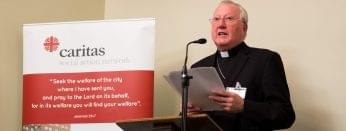


This reflection was written by Nikki Dhillon Keane, Head of Caritas Hope at Caritas Westminster, and explores the often invisible suffering associated with mental distress, trauma and isolation. Drawing upon her experience as a psychotherapist, Nikki challenges us to consider how our parishes and communities might become places of genuine safety, understanding and compassion for those experiencing mental anguish.
Launched in October 2026, Caritas Hope brings together two established Caritas Westminster services: Safe in Faith, which provides faith-informed support and training concerning domestic abuse and trauma, and Signs of Hope, which offers specialist counselling for Deaf, Deafblind and Hard of Hearing people.
In this reflection for the first day of CSAN’s World Day of the Poor Novena, Nikki invites us to recognise the suffering that often remains hidden behind everyday interactions, and to consider how simple acts of listening, friendship and solidarity can become expressions of Christ’s love.
As we reflect on the many faces of poverty, the different things which impoverish our lives, we can turn our thoughts to people who are unable to flourish because of some form of mental distress. Pope Leo has spoken of “the silent wounds that sometimes no one sees.” Mental health problems are often invisible to others; we may be unaware of the internal pain carried by those we see each day.
It can be difficult to talk about mental health problems; despite increasing awareness, they are still too often a cause of stigma and judgement. Yet mental health problems are not rare. The likelihood that any of us could be affected at some point is extremely high. According to MIND, across England, each year, one in four of us are affected by mental health problems with half of us having met the criteria for a mental health diagnosis at some point during our lifetime. While mental health issues can affect anyone from any walk of life, people living with financial poverty are disproportionately affected. A study from the Centre of Mental Health found that people are twice as likely to experience a mental health problem if they are living in debt. Mental health, including access to mental health support, is a social justice issue.
At any time, in our parish communities, there are people struggling with their mental health, often fighting their battles beneath a mask which tells the world that everything is fine. There are people who sit among us feeling completely alone. There are people for whom walking outside their front door is like climbing Everest. There are people whose pain is so great that it is a battle to want to stay alive until the end of the day. One of the worst things about depression is its ability to convince you that you are alone; that no-one would want to support you if you reached out for help. It tells the lie that you, a precious and beloved child of God, are broken and unlovable. Depression and anxiety can isolate you, disconnected from the love of those around you, from the love of God, from Hope.
This disconnection only serves to worsen mental distress. Connection is the single most important factor in wellness. Longevity studies have found that having meaningful relationships with others in our community is more important than diet or exercise as a factor for living well into old age. A form of wealth we often don’t recognise, is in experiencing safe connections with others. Yet there are many experiences which make that difficult or impossible. While some of those experiences may be associated with different mental illnesses, others may develop as a result of trauma, particularly the kinds of trauma caused by abuse or oppression.
Trauma itself is not a mental illness, but an adaptive response to maladaptive experiences like abuse, but it can still be a cause of extreme mental distress. People living with trauma often have disturbing experiences like flashbacks, dissociation, hypervigilance or difficulty relating to other people. These experiences can be unpredictable, set off by something as small as a smell or colour associated with an experience of harm. The smell of beer on someone’s breath can trigger an intense flashback. Trauma can leave you trapped in the past, unable to connect with those around you in the present.
Mental distress can be caused by a disordered perception of reality, but in many cases, it is a response to very real situations of chronic insecurity, oppression or abuse. The anguish of not being safe, or not being able to keep your children safe, may be difficult for some of us to imagine, but it is known by Christ. In the garden of Gethsemane, knowing he would be put to death, Christ is described as sweating blood, something which can happen to our bodies in extreme “fight or flight” response. In his most human moment, Christ’s autonomic nervous system was activated by his divine knowledge of what was to come. And in that moment, as his friends fell asleep, like so many of us in our darkest moments, he felt alone.
Christ, who knows aloneness, hopelessness, fear, never leaves us truly alone in those moments. Christ is present through all our moments of terror, of self-loathing, of disconnection from the world. He holds us in our isolation, through every sleepless night, every day that we wait for each painful minute to end. Christ is there.
Christ is there because we are there for each other. As St Theresa of Avila tells us, we are the eyes and ears and hands and feet of Christ on this earth. And so it is through us that Christ is with those who suffer alone. If the Church is to be a place of refuge, it is us who must make it so. It is through us that the Church can become a place of safety, where people can reach out for support without judgement. In a trauma-informed, mental health aware Church, what might be different?
How might we notice the people who sit beside us on the pews hiding their pain?
How might we connect with people whose thoughts feel so scattered and jumbled that they cannot connect with themselves?
How can we be a safe refuge for people who have been so shattered by hurt that they can only see threat?
How can we invite someone to feel truly at home when they have felt judged and excluded for being different?
How might we reach people who are trapped in their home?
Just by taking a moment to really look someone long enough to see past their “Fine thanks, and you?” we can create the opportunity to say “If you’re ever not fine, I’m here.” We cannot all be mental health professionals, but we can sit and listen. That is more important than it might seem. As a mental health professional, there is something you can do that I can’t. The domestic abuse survivor and author Waynetta Dawn has said that when she was at her lowest, she felt that the only people who would listen to her were the people she had to pay for. While professional mental health support can be vital, there is something incredibly powerful about being there for someone, not because it is your job, but purely out of love. It is that love which can sometimes give someone enough feeling of self-worth to engage with formal support. For some people, that can be life-saving.
Talking openly about mental health can save lives.
What might we change if we talk about it in homilies, and in newsletters, and in conversations over coffee after Mass. Or if we look out for people who sit alone; aware that we might be the only person they have spoken to all week. If we find out what help is available for people who are struggling, and have helpline numbers on Church noticeboards and in newsletters. If we take the time, however rushed we are, to sit for a moment and listen, what might change? For someone in their garden of Gethsemane, the answer could be everything.
If you or someone else is experiencing a mental health emergency, call 999 for an ambulance For less urgent medical support, call NHS 111. You can get support online at https://111.nhs.uk/
You can find mental health support from these places:
The Samaritans www.samaritans.org Phone 116 123 Email jo@samaritans.org
National Suicide Prevention Helpline UK 0800689652 6pm to midnight daily
SHOUT text support text SHOUT to 85258
MIND www.mind.org.uk 03001233393
CALM (Campaign Against Living Miserably) www.thecalmzone.net 0800585858 5pm to midnight daily
Young Minds www.youngminds.org.uk
Childline www.childline.org.uk 08001111
Caritas Safe in Faith trauma training for parishes https://caritaswestminster.org.uk/safe-in-faith
Caritas Safe in Faith Signposting Toolkit https://caritaswestminster.org.uk/wp-content/uploads/2025/11/Signposting-Toolkit-nov-25.pdf