
Day 9 Reflection | World Day of the Poor Novena 2026
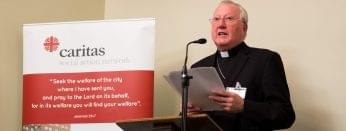
This reflection was written by Jenny Sinclair, Founder and Director of Together for the Common Good, an organisation dedicated to renewing relationships, strengthening communities and promoting the common good.
For the ninth and final day of our World Day of the Poor Novena, Jenny offers a challenging reflection on the social, spiritual and relational dimensions of poverty, asking whether our increasingly individualistic society has lost sight of what it means to flourish together.
Drawing upon Catholic Social Teaching and Pope Leo XIV’s message for the World Day of the Poor, she invites us to move beyond approaches to charity centred solely on service provision, towards a renewed commitment to communion, solidarity and shared responsibility.
At the heart of her reflection is a powerful challenge to our parishes, charities and communities: how might we build the kingdom of justice, love and peace together, rather than simply delivering assistance to those in need?
On this ninth and final day of the novena, the Church prays “that we all may be committed to building the kingdom of justice, love and peace.” This prayer asks two things of us: an honest reading of what is happening around us, and the recovery of what the kingdom has always required – communion.
Reading the Signs of the Times
Pope Leo’s message for this year’s World Day of the Poor takes its theme from Psalm 14: “The Lord is the refuge of the poor.” He reads the psalm as a warning about “widespread social injustice” and is clear about who pays the price: “The poor are the first to suffer the consequences.” He names “a desecrating logic of abuse and exclusion”, one that “marginalises and humiliates.”
The consequences of this logic are all around us. The man leaving prison with a discharge grant and nowhere to belong. The young mother in work yet still needing the food bank. The refugee family in a hotel room thousands of miles from home. The man in his fifties, out of work and on the street, plagued by suicidal thoughts. The boy trapped in county lines because the gang was the only group that paid him attention. Thousands experiencing loneliness in a culture more digitally “included” than ever.
Step back, and these human tragedies form a picture of lost dignity, of denied agency, of not being known. The poor of our time, Pope Leo writes, are “robbed not only of bread, but also of a voice and a face.”
The experience of poverty is rarely only material. Often it is relational too: having no trustworthy adult, no neighbour looking out for you, no dependable family, no one with whom to share life. And it can be spiritual: feeling that you have nothing worth giving, that nobody expects anything of you. Living without a relationship with God can mean a life without a sense of meaning or purpose.
So what connects these things?
A Bad Idea
For several decades, across the West, we have been living through a vast social experiment, organising society around the idea that we can live well without God. What remains is a culture built around the autonomous individual: my choices, my identity, my preferences. This is the sea we swim in.
At its core is a particular idea of freedom: freedom from constraint. That birthed a culture promoting freedom from family, from place, from tradition, from history, from God – even from human nature, and from reality itself. This dogma rests on a false anthropology: the belief that we are isolated individuals – a soulless, desiccated conception of a human being. Rights matter, but a culture of rights without responsibilities wears away the ties that bind.
The same idea shaped our economy. Individual freedom and the freedom of capital were two sides of one coin: money moved, and industry left whole towns, leading to the loss of not only work but identity and inheritance. Local institutions through which people learned how to live together – the association, the club, the high street business, the co-operative, indeed the parish – were weakened.
The market persuaded us it could meet our needs. The state stepped in where jobs should have been. Successive governments have perpetuated this failing system, and the result is collapsing trust, fragmentation, a polarised politics of identity, rising discontent and a crisis of meaning. For many, exposed to the dehumanising effects of both market and state, life has become too hard.
We have been living against the grain of creation, and when reality is contradicted, things begin to break. Pope Leo puts it in a single sentence: “The absence of God no longer places people side by side in mutual respect, but places one above the other in a relationship of domination and oppression.”
Christian organisations have not been immune. The logic of the autonomous individual breeds a culture that puts metrics, regulatory frameworks and professional habits before God and human encounter. Our social action has not escaped its influence: unless we are vigilant, the service-provider dynamic, however kind, turns neighbours into recipients and inadvertently cultivates dependency. Our language betrays the drift: neighbours become “clients”, “service users”, “projects”. Even “charity” has come to mean service provision.
Sometimes, too, we have absorbed the assumptions of the dominant culture so deeply that we have let faith fade – by flattening our Catholic distinctiveness to secure funding, or by letting professionalisation take precedence over formation. Adept at strategy, outcomes and risk management, we have grown less attentive to prayer, to discernment, to the Holy Spirit.
Is it any wonder, then, that despite all the funding and the millions of volunteer hours, poverty has not declined? For those in deep poverty, things have got worse.
We have built a system in which professionals and volunteers carry burdens that families, neighbours and parishes once shared, making it ever easier for the rest of us to hand our responsibilities over.
If this sounds harsh, remember that Pope Francis consistently warned against delegating charity to others, urging that “the calling of every Christian is to become personally involved.” Pope Leo is now pressing the same challenge, asking questions which, he says, “call for a serious examination of conscience.” That is the heart of a novena: in repentance, to turn back to God.
Made for Communion
So what is the antidote? It begins with remembering who we are. Scripture’s first word about the human being is not that we are autonomous, but that we are made in the image of God – Father, Son and Holy Spirit, a communion of love. We are relational beings, made for one another and for God. We flourish through belonging.
Then remember what Psalm 14 means by refuge. It is the Lord who is the refuge of the poor. He does not care for the poor at arm’s length: “In Jesus, God not only protects but shares in human poverty all the way to the cross.” That is the pattern of the kingdom: not provision from above, but presence alongside. A refuge must be a place where a person is known and at home.
When the Holy Father writes that “the Church, by its very nature, is called to be poor and a refuge for the poor”, he is describing a way of living. A true refuge listens, walks alongside, shares hopes and stories. “Are we aware of our own poverty?” asks Pope Leo. A Church that is a refuge opens its doors knowing it is poor too: it knows how to ask for help, not only how to dispense benevolence.
Today’s prayer names three words: justice, love and peace. Each points to an aspect of the shift from service to communion.
Justice: Asking Why
Catholic social action has become very good at responding to the consequences of poverty – so good that the systems and ideas that generate it often remain untouched. We can too easily convince ourselves that social action is the same thing as social justice. It is not. Catholic Social Teaching asks deeper questions – about the family, the structures of political economy, the dignity of work.
What if wages are too low to live on? What if the work available cannot provide meaning? What if decisions are made without the consent of the communities affected? What if the system itself traps people on benefits? What if the weakening of the family lies behind the addiction, homelessness and mental health crises we try to address?
A crisis response that becomes the norm is not justice. Escaping this trap means sharing in people’s lives, being willing to hear uncomfortable truths and allowing ourselves to be changed. As St Oscar Romero put it: “A church that does not join the poor, in order to speak out from the side of the poor against the injustices committed against them, is not the true church of Jesus Christ.”
Love: With, not For
Charity, rightly understood, is love – and love begins when a person is truly seen. Pope Leo writes that Jesus “calls each person by name and restores dignity to all.” Yet our systems too easily reduce people to categories.
Everyone has something to give. The family with dad in prison, the refugee, the community alienated from the mainstream: each has gifts to offer, and each is precious to God and held, as we all are, within the possibility of redemption. They must never be seen merely as recipients. The prevailing culture focuses on entitlement; but the Christian question is how the Holy Spirit is already at work in each person’s life.
Pope Leo challenges the division between helpers and helped. We are called, he says, “not to distinguish between those who assist and those who are assisted, between those who seem to give and those who seem to receive … Each one is a gift for the others.”
Peace: Seeking the Welfare of the City
Peace, in the biblical sense, is shalom: not simply the absence of conflict, but right relationships restored. When Jeremiah wrote to the exiles in Babylon, he told them to “seek the welfare of the city … for in its welfare you will find your welfare.” The word he used is shalom. Our peace is bound up with the peace of our neighbours.
This is what the Church means by the common good: the good of a shared life. It means acting together to create the conditions in which every person, every family and every institution can flourish, each taking responsibility according to their gifts and abilities.
In practice, that means a shift from “What can we do for you?” to “What can we do together?” I know a small homelessness charity in East London where, on walking in, it is impossible to tell who is staff, who is a volunteer, who was once homeless and who has come for help. People cook, eat, work and take responsibility together. That is what Pope Leo means: “Then we will see that the poor themselves become a refuge for others.”
Let me say a word about the parish, because I believe it is at the heart of building the common good. A parish comes alive when it turns outward to its neighbours. It carries an inheritance: a covenant with every soul in a place, whether they come to church or not. Rooted in the sacramental rhythm of worship, its life should overflow into a desire to go out and listen. In this way, the parish becomes an incarnate presence in its neighbourhood. It learns to receive as well as give. And it must be willing to sacrifice its own comfort, making room for the noise and energy of people through whom God is also working.
The Rebuilding
Though the crisis of our time is real, we are not meant to face it alone. The recovery of communion is a shared vocation. When Nehemiah led the rebuilding of Jerusalem’s walls after their destruction, families each took responsibility for a section, working side by side. Pope Leo reaches for this image: each of us, and each parish, is to rebuild our own part of the wall.
As we consider what this means for our parish, our school or our charity, we might begin with an examination of conscience. Does our work of repair strengthen relationships? Does it increase agency, foster reciprocity and enable responsibility? Does it distribute power? Does it help people discern the movement of the Holy Spirit? Does it deepen our Christian identity and create opportunities for communion?
Pope Leo wants this World Day of the Poor to prompt us to rediscover brothers and sisters who “long to feel at home in our communities.” This is about more than improving the way we serve people in need. It is about recovering a sense of belonging and shared responsibility. The kingdom of justice, love and peace is not something we deliver to poor people. It is something we build together, as members of one another: one relationship, one parish, one neighbourhood at a time.
Jenny Sinclair is Founder and Director of Together for the Common Good