
CSAN Blog

Calais: Donations dispersed with dignity


By Kathleen O’Brien, a parishioner of Faversham, on her recent trip to Calais

I’ve visited the camp in Calais twice now and seen men queueing by the roadside to receive food and clothes. I was struck by how much more dignified it was for them to be greeted, welcomed and given time to choose shoes that fitted. Before they left, each man was asked whether he needed a blanket or sleeping bag and was handed one from the stack by the far wall.

“Where do the donations come from?” “All over France,” replied Christine, “and some from Belgium and some from the UK.” She estimated the blankets would all be gone by the end of Saturday. Léa explained that, in the months it had taken to gain the necessary permissions to open this facility, donations had built up. Now that it is open, they will soon disappear.

Organisation

Through Léa, Christine explained that Caritas France (equivalent to CAFOD in England and Wales) is the Catholic Church’s overseas development agency and assists with international emergencies, while Secours Catholique is a bit like CSAN in the UK – dealing with social needs within the country.  “Because the refugees are here in Calais, we (Secours Catholique) are helping them.”

“What will happen if the camp is destroyed?” Léa shrugged, “They will disperse and make new camps. They don’t know where to go, where to live. Most want to live in the UK. It is a complex problem. The UK cannot accept everyone.”

Ahmed

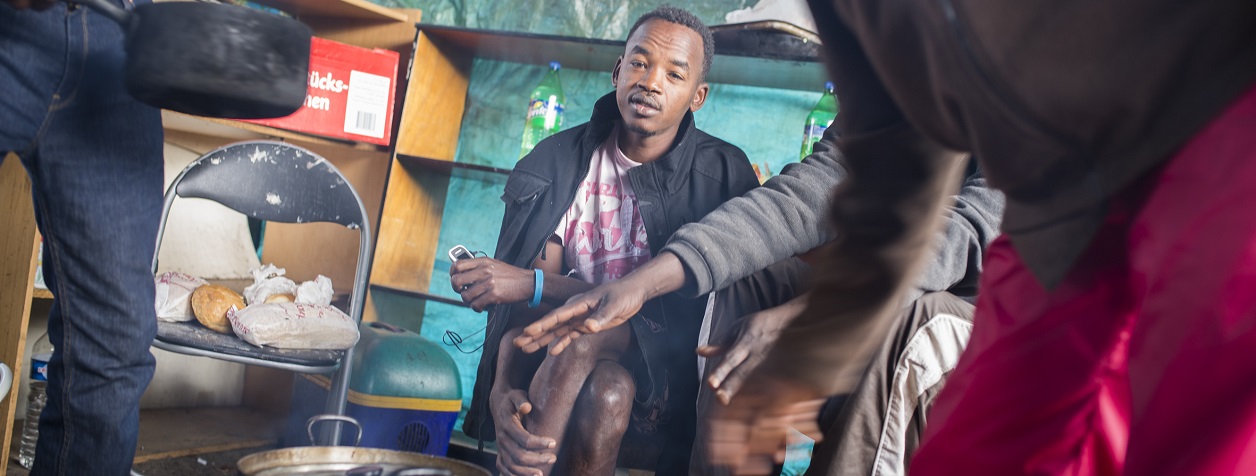
Outside, I asked whether anyone spoke English. A tall young man stepped forward and introduced himself as Ahmed from Sudan.

Ahmed had lived on the streets in Italy for a month before hearing that things were better in France. I asked how he had been able to afford a train ticket. “No ticket, no money”, he told me. When the inspector asked for his ticket, then for money, he explained that he had none. The inspector put him off the train at the next station, and Ahmed simply waited for the next train.

He had been in Calais two months and thought that numbers in the camp were growing. He said that there was more food here than in Italy, “lots of organisations for food”, but that there was still not enough. Sometimes it might be two days between meals, but he had eaten last night.

I asked whether he thought that the camp would be destroyed. He said he hoped that the ordinary people would fight the government and it would not happen.

Ahmed told me he had left Sudan because it was not safe for him to be there. “My parents are still in Sudan. I ring them sometimes when someone gives me a phone.” Ahmed said, “If I could I would stay in France.” He had begun the application process for asylum but said it was not easy: “I just want protection”. He concluded: “If my country became peaceful, I’d go to my country.”


The views expressed in this blog are not CSAN policy.

MPs want to reduce homelessness, but the prescription is having unwanted side effects


By CSAN Policy

16 November 2016 marks the fiftieth anniversary of the BBC’s first broadcast of ‘Cathy Come Home’, highlighting conditions of compounding seriousness in which people with housing difficulties could find themselves (one thing leading to another); the stigma and scapegoating associated with poverty and homelessness, and a chronic shortage of housing support from public services, if families and friends were unable to bear the burden.  On a first viewing of the film, the issues and attitudes can seem stunningly familiar in 21st Century Britain.

Over intervening decades, numerous ‘policy solutions’ to various types of homelessness have been tried.  Average life expectancy rates for people with a history of rough sleeping have improved over time.  But so has average life expectancy overall.  The gap between these rates remains large.  In addition, over the next 15 years, gaps in life expectancy for the whole population are expected to widen on socio-economic lines, reflecting increased income inequalities for example.

Despite creation of what some term a ‘homelessness industry’, with innumerable campaigns, celebrity patrons, large-scale professional organisations, the invention of ‘pathways’, and the injection of vast sums of public money, there is remarkably little evidence that any of these solutions have directly improved future life chances for new generations of people, whose histories are most likely (statistically) to predict housing challenges.  Too often, specialist analysis degenerates into questions of retrospective attribution, blame, or chicken and egg.  While there is plenty of finger-pointing about inadequate housebuilding and the impact of welfare reforms, it seems almost taboo to ask whether emerging family structures and social patterns of behaviour will exacerbate homelessness in future.

One of the striking features about ‘Cathy Come Home’ is the way in which family and neighbours try, with varying degrees of will and capacity, to help her manage the initial situation.  The play shows how good will can dry up even where there is a foundation of social capital, a network of support in times of crisis.

It has become fashionable to say that ‘homelessness is not inevitable’.  But what does this mean in terms of mutual responsibilities within families, communities and organisations?

First, perhaps it implies that every individual has a choice to ignore or close the door on someone who faces difficulties with housing.  If only it were so simple.  It might be more accurate to say that the soundbite reveals a more informed uncertainty following policy approaches of the last fifty years.  Where centred on statutory support, these approaches have delivered a clear message: a professionalised pathway for tackling homelessness is ultimately a temporary solution – it is limited by annualised budgets, the supply of skilled staff, maintaining professional boundaries, and avoidance (of fraud, being sued, or other risks to the provider).  In 21st Century public services it is further limited by quasi-science and contracting.  Not only is the person without a home a person to be labelled by category of need, but she/he becomes part of an artificial group – which is certainly not a community – valued not for the gifts and strengths of the individuals within it, but by being assigned ID number(s) within a ‘vulnerable group’, and then to receive a pre-defined ‘intervention’ from a database of ‘what works’.

The Communities and Local Government Select Committee has been inquiring into homelessness (note 1), but the ‘next generation’ solution seems like more of the same.  These legalistic models appear by their very nature to be eroding the irreplaceable social capital that, in its very vulnerability, makes us more human.

Note 1: House of Commons, Communities and Local Government Committee, Homelessness, Third Report of Session, 2016-17.

The views expressed in this blog are not CSAN policy.

Hate crime against travellers


By Faith Anderson, Public Affairs Officer

The fact that the Traveller community experiences hate crime is one thing – but what is shocking is that it is not addressed.

The authorities are, at best, indifferent and, at worst, hostile to the Traveller community. In the experience of the CSAN member charities, who work with Travellers if an incident of hate crime is reported, there is a very slim chance that the police will act – and an even slimmer chance that there will be a prosecution or some kind of retributive action.

Naturally, this fosters a relationship of disappointment and mistrust between the victims of hate crime and the authorities – what is the point of reporting abuse if you do not expect that you will be listened to, or that the incident will be properly logged, or that there will appropriate action taken?

The Traveller Movement, a charity which campaigns for the rights of the Traveller community, conducted a Discrimination Survey in 2016. Although 98% experience hate crimes, only 27% seek some form of redress. This means that the vast majority of the Traveller community are experiencing abuse or discrimination because of their ethnicity, and the majority do not feel that they can do anything about it through the channels of the criminal justice system.

Can you imagine this from any other community? Can you imagine a survey which found 98% of Catholics had experienced hate crime? Can you imagine going to a police officer to report being denied access to services, the vandalism of your property or physical or verbal abuse and seeing them do nothing about it?

This is the reality of what the Traveller community faces. In particular, abuse online and in the media is completely tolerated. Recent examples include One policeman vs 30 TRAVELLERS: Invasion of caravans and vehicles; Travellers are evicted from London park after getting in through gap in the fenceposts; £3m taxpayer-funded gypsy camp housed a giant cannabis plantation. I cannot help but think that if the media talked about any other ethnic groups in this way, it would not be accepted.

A reciprocal relationship of trust and respect needs to be built, in which the Travellers contribute to and live in harmony with their communities – communities which welcome and respect them in turn.

One side needs to reach out and end the cycle of animosity – and as the majority of Travellers are Catholic, perhaps the Catholic community is best placed to open our Church’s doors, literally and metaphorically, to this community – so that racism against them is eventually condemned as racism ought to be.

This week, for Hate Crime Awareness week, the Gypsy Roma and Traveller communities should not be forgotten.

Did you know that discrimination against the Traveller community was a major issue?

Find out what else is going for National Hate Crime Awareness Week on Twitter with  #NHCAW


The views expressed in this blog are not CSAN policy.

Prisons Week


Katie Milne, Parliamentary and Communications Assistant

Today marked the beginning of the 40th Prisons Week, an annual week of prayer for all those affected by prisons and crime, run by the Christian community and this year especially inspired by Pope Francis’ Year of Mercy. The shared common prayer of ‘Lord, have mercy’ captures the crux of a campaign that aims to break down barriers between estranged prisoners and the judgement of the outside world. Faith Anderson (Public Affairs Officer) and I saw first-hand the fruits of this prayer when we visited HMP Pentonville today to sit amongst prisoners, parishioners, and church and charity leaders. The punishment, condemning and despair of prisoners was not the focal point, for the message of forgiveness of prisoners proved to be refreshingly persistent. A memorable moment was hearing a former Pentonville inmate give a spoken word performance which expressed the urgent need to centre prayer on the difficult journey many prisoners have found themselves on, and to avoid the passing of judgement and shame. The poem was especially moving when, mid-performance, he held his arms out in surrender  – serving as an emotive prompt for the congregation to say ‘Lord have mercy’ together.

Throughout the rest of this week, Prisons Week will continue to hold events for other groups affected by prisons and crime, including victims, families, communities, and for those working in prisons and in the criminal justice system. At the event today also, organisers drew attention to Prison Hope. As a year of prison focus for churches, Prison Hope aims to improve the connection between local churches in and outside of prisons during 2017.  This may be achieved through encouraging many more churches to pray for their local prison and developing a volunteering network to carry out great work within the prisons themselves. Essentially, the power of hope in inhibiting despair is the overriding message of the campaign, and it is largely facilitated by the sharing of stories about the hope Christianity can instil within all those affected by prisons.

The following prayer for Prison Hope reveals the pressing need for the development of the relationship between prisoners and communities, while also providing meaningful prayer:

Gracious Lord,

who told us to look for you

in the isolated and the excluded,

bless, we pray, the efforts of Prison Hope

to stir up your Church.

Give us wisdom to restore the fallen,

encourage the fainthearted,

welcome the stranger

and proclaim the year of the Lord’s favour –

even the redemption of our debt

through your grace and mercy.

Amen.

To find out more about Prisons Week visit www.prisonsweek.org for information and prayer resources.

The views expressed in this blog are not CSAN policy.

Eight things everyone should know about mental health in the UK


Porsha Nunes-Brown, Network and Communications Officer

Mental health is a major issue in the UK, with one in four adults and one in ten children experiencing mental health problems every year. Today, it’s World Mental Health Day which aims to raise awareness of mental health issues and to discuss what needs to be done to make good mental health a reality for everyone.

  1. Anyone at any time in their lives can be affected by mental health, but there are some specific groups who face higher risks including children with parents who have mental health or substance misuse problems and looked after children. Concerning adults, those who have been homeless, adults with a history of violence/abuse, refugees and isolated older people face a higher likelihood of experiencing mental health issues.
  2. Traumatic events including road accidents, serious illnesses can result in long last mental health issues – around one in three adults in England have experienced at least one traumatic event which can lead to Post-traumatic stress disorder (PTSD) and depression.
  3. Different ethnic groups have different experiences relating to mental health – Black and minority ethnic groups are more likely to be diagnosed with mental health problems and more likely to experience a poor outcome from treatment. Research suggest, Irish people have higher rates of depression and alcohol problems whilst African Caribbean people are more likely to enter mental health services via the courts or the police.
  4. Poor mental health has substantial consequences in today’s workplace – 70 million working days are lost each year due to poor mental health, costing Britain annually £70-100 billion. The stigma surrounding mental health creates an environment in which employees do not feel able to discuss openly with their line managers their struggles with stress.
  5. Gender plays a role relating to mental health –Women are 20-40% more likely to develop a mental health problem however men aged 20-49 are more likely to die from suicide than any other cause of death.
  6. There are geographical differences concerning mental health – prevalence of mental health illness in Northern Ireland is 25% higher than England. The North East has the highest suicide rate in England while London has the lowest.
  7. Poverty increases the risk of mental health – during economic downturns, people with no previous history of mental health may develop mental health issues due to having to deal with the constant stress of job uncertainty and the impacts of financial tribulations.
  8. People with mental health issues are more likely to be victims of violent crimes and experienced intimate partner violence – it’s estimated that 60% of female mental health service users have experienced domestic violence.

The prevalence of mental health problems in our schools, workplaces, hospitals and families can no longer be ignored.

How do you think we can better help people affected by mental health challenges?


The views expressed in this blog are not CSAN policy.

Calais: In their shoes


By Kathleen O’Brien, a parishioner of Faversham, on her visit to the clothes distribution centre in Calais

A short journey

As my parish in Kent is closer to France than London, I feel that the Calais refugees are my next door neighbours. So, this Monday, after hearing that CSAN’s sister agency Secours Catholique had opened a new facility to assist migrants, myself and a fellow parishioner, Marie, set off to investigate.

When we rolled off the Dover ferry in France, our supposedly European sat nav refused to cooperate: “Calais? Would that be in Surrey, Northampton or Wales?” Fortunately the facility at 39 Rue de Moscou turned out to be only two streets from the port.

The Migrant Relief locker room

Secours Catholique has volunteers on hand to receive donations on Mondays and Wednesdays from 2-5pm. We’d chosen to visit on a Monday which also coincided with a distribution of footwear. As we arrived at the warehouse, or ‘Migrant Relief locker room’, men were gathering at the gate.

We passed a small van parked in front of the open doors and two volunteers unloading boxes of donations. Inside, others were busy sorting clothes into organised-looking piles in different parts of the space. There was a sense of efficiency and purpose. We added our donation to the ‘in tray’ then went through to the far end of the warehouse.

The locker room

Here a rudimentary free ‘shop’ had been set up. Four volunteers stood behind a counter made of two tables. Behind them, shoulder height racks of footwear, mainly trainers, were arranged by size. Beyond the glass entrance door, we could see a number of young men on a row of chairs in the courtyard, patiently awaiting their turn.

The volunteer manager, Christine, a small, softly-spoken woman with a quiet authority, stood by the entrance. When we apologetically asked, “Do you speak English?” she called over her granddaughter, Léa, a lively young woman in her twenties. Léa speaks very good English and told me that she is a law student, helping at the warehouse until term starts next week.

As we watched migrants and refugees having their feet measured and being handed shoes to try on, Léa told me that they were expecting about 100 people today but on Saturday, when clothes are distributed, there will be 300—400 people. Even with today’s comparatively small distribution of footwear, Léa believed that the warehouse would have run out of some sizes by the end of the day.

The views expressed in this blog are not CSAN policy.

Five ways you can help in your local community


Porsha Nunes-Brown, Network and Communications Officer

Today is the International Day of Older Persons, a day aimed at drawing attention to and challenging negative stereotypes and misconceptions about older persons and ageing.

At CSAN, we’re committed to improving the lives of older people living in the UK. As a society, we need to acknowledge how members of the older population significantly contribute to our society. There are a number of ways you can help older people in your local communities:

  1. Talking – According to Age UK, half of all older people consider the television their main form of company. Loneliness is a major issue for older people. Simply, starting a conversation with an elderly person in your local area, asking how their day is going is valuable.
  2. Volunteering – There are a number of voluntary opportunities available at organisations that work with older people ranging from telephone befriending to visiting older people who have been recently discharged from the hospital. Providing care and support to older people is a key priority for some of our members including Catholic Care (Diocese of Leeds), Caritas Salford, Irish Chaplaincy, Nugent and SVP. Visit www.do-it.org.uk to find voluntary opportunities in your local area.
  3. Exercise – The importance of physical activity and exercise for older people should not be understated, regular exercise can improve physical and mental health. Offering to accompany an older family member and/or local community member to an exercise class or simply for a casual walk would be a great way to stay active and to meet new people.
  4. Cooking –  Some older people find it hard to cook for themselves, as a result cooking a meal for an older person in your local community may be greatly appreciated. There is an amazing project called The Casserole Club, designed to connect people who like to cook with their older neighbours who aren’t always able to cook for themselves.
  5. Learn more– Make it a priority to learn more about challenges facing older in the UK and in your local community. There are several organisations that work in this area including Age UK, Centre for Ageing Better and Contact the Elderly.

Those are just a few ideas of how you can better support older people living in your local area. We all need to work together to ensure older people living in the UK are living happy and fulfilled lives.

The views expressed in this blog are not CSAN policy.

Calais: A reflection on walls


Guest blog by Kathleen O’Brien, a parishioner of Faversham

Lakeland walls

Last week, walking in the Lake District, I was again struck by its beautiful dry stone walls. They are both works of art and living structures, clothed in mosses and lichens, inhabited by tiny plants and insects. They keep the sheep from straying onto a road, but allow the wind to blow through them, and have stiles built in for walkers to pass through easily from one field to another.

How different from the wall going up in Calais: four metres tall and stretching a kilometre on both sides of the dual carriageway into the port, built of smooth concrete so that it will be harder to climb. A wall intended to keep refugees out of the UK.

At the same time, across the Atlantic, Donald Trump promises to build a “beautiful” wall between the United States and Mexico.

Historical walls

Perhaps all this wall-building is not so surprising. After all, it has been going on for centuries: Hadrian’s Wall, the Great Wall of China, the Berlin Wall… It seems that whenever we are afraid, our first instinct is to build a wall to hide behind. Block out the problem. Don’t let it get to us.

But are walls the answer? Have they worked in the past?

Biblical walls

It would appear not! I took Biblical Studies at university, so any talk of walls brings to mind the walls of Jericho (which fell down under the pressure of trumpets and shouts of faith) and the walls of Jerusalem (which were built, destroyed, rebuilt and – seventy years after Jesus – destroyed again).

However much the people of Judah saw Jerusalem’s walls as protecting them, ultimately, they didn’t. Walls are not the solution.

Calais wall

And that was much the feeling of Steve Symonds from Amnesty International, quoted in The Guardian (20.09.16). He said: “This wall will simply push desperate people further into the hands of smugglers and into taking far greater risks to get to the UK, and more will die in the attempt.”

A challenge to live outside the walls

So how can we make our country, and our world, more secure?

How easy it would be for Christians to answer that question if Jesus had been a wall-builder!

Instead, Jesus reached out to foreigners, spent his time with outcasts and became ritually unclean by touching lepers and dead bodies. He chose to live his ministry beyond the limiting walls of expectation and convention, culminating in dying “near the city”, in other words outside the walls. He didn’t build walls, but lived and died beyond them and broke them down. St Paul wrote, “He himself is our peace, who has made the two groups one and has destroyed the barrier, the dividing wall of hostility” (Ephesians 2:14).

No easy answer for Christians. But a life-promising challenge, if we choose to accept it.


The views expressed in this blog are not CSAN policy.

We need to protect and support our young offenders


Porsha Nunes-Brown, Network and Communications Officer

I attended the Policy-UK Forum’s conference, ‘Young People in the Justice System Delivering a Positive Outcome: Early Intervention, Education and Reducing Reoffending’ on 13 September 2016.  The day was packed with a range of guest speakers, with the main objective of learning how we can work together to improve outcomes for young offenders in the UK.

Chief Constable Olivia Pinkney, Lead Officer for Children and Young People, National Police Chiefs Council spoke about the role the police can play in avoiding unnecessary criminalisation of young people. She highlighted that a young person should be seen as a child first, and arresting a young person should always be the last resort. The police are wrestling with new offences, as we’re witnessing new behaviour including cyberbullying and sexting from our young people. She was clear that the police need to record all crime but they need be able to use their discretion when appropriate.

Anna Henry, Director of Child Rights, Office of the Children’s Commissioner, outlined the changes needed to improve outcomes for young people in the criminal justice system. The priority should be achieving a child centred justice system, not a cost centred justice system. For example, the voice of the child isn’t heard enough and a rights-based approach might improve the balance . Children in care are a group tending to have high and complex needs, calling for a focus on recovery over punishment-based approaches. The need for partnership working was emphasised and encouraged.

The secure care home model had been found effective and it was recommended we build on this model. This is aligned with the findings of the Narey Review, an independent review of children’s residential care in England. It was found that secure care has the capacity to keep children safe, and the evidence highlighted secure homes achieve both educational and health outcomes for children. Normandie Wragg, CEO of Nugent commented in our response to the Narey Review stated, “the review tackles many of the misconceptions relating to secure care. I strongly support Narey’s judgement that secure care has the capacity to keep children safe and the evidence highlights secure homes achieve both educational and health outcomes for children”.

It’s clear that we require the buy-in and support of prison officers to effect any change, as we know the reality is that some young people will end up in the criminal justice system. Ralph Valerio, National Vice Chairman, Prison Officers’ Association outlined 4 areas of focus:

  • Education and Employment
  • Health & Wellbeing
  • Service Users’ Participation
  • Prison Officers

He passionately spoke about the mental health challenges many offenders struggle with and the importance of fully integrating drug and alcohol programmes. Relating to employment, he called for major companies to form partnerships with prison governors throughout the country.

It was great to hear the amazing work being done by the Prisoners’ Education Trust presented by their CEO, Rod Clark. He spoke about the current 30-hour education target for young offenders which isn’t being met. However, the risk of having a weekly target is that it becomes the goal and thereby reduces focus on specific outcomes for young people. To help improve the educational outcomes of young offenders, he first asserted we need to understand the importance of relationships for children who have experienced abuse, injury and family breakdown. Secondly, there is a need to establish a learning journey that all parties are committed to. Agencies should also be working together to expand the provision of distance learning.

Overall, it was a very insightful day. I left feeling very enthused with the number and range of individuals and organisations that possess the skills and expertise and the willingness to achieve positive outcomes for young offenders.

The views expressed in this blog are not CSAN policy.

Helping vulnerable women to gain control


Porsha Nunes-Brown, Network Development Officer

Women@thewell helps 250 vulnerable women every year. They provide a safe space for vulnerable women with complex needs. Women@thewell cater to women affected by street based prostitution, homelessness, mental health and trafficking.

The centre is ran by a team of dedicated staff and volunteers who support and empower women to take control of their lives, with providing help accessing health services, securing accommodation and assistance with receiving the right benefits and debt management.

I spoke with Caroline Hattersley, Head of Services, about the essential work carried out by Women@thewell and her future plans for the organisation.

On a daily basis, 15-40 women visit the centre. I was extremely impressed by the range of activities and services offered including:

  • Arts and crafts
  • Cookery
  • Gardening
  • Employment workshops
  • Reflexology
  • Sewing
  • Tai chi

Creativity and change

During my visit, I was able to see the various ways women were able to showcase their creativity from the walls of paintings to the number of musical instruments available to be played. Women@thewell truly embody their mission of providing a holistic service to disadvantaged and vulnerable women.

The drop centre is open Monday-Friday 12:30-3:30. The centre is open to all vulnerable women on Wednesday afternoons.

I spoke to a few women about their lives and aspirations. One woman, Patricia, passionately discussed her love and commitment for her two children and how she was coping with how they were growing up so quickly.

I was truly moved by Sarah, her determination and warm spirit were inspiring and endearing. Despite facing multiple challenges, she had found a way to harness her creativity through the making of jewellery. She had a bag full of earrings – all different colours and sizes, which she regularly sells at local markets. It was truly uplifting to witness someone refusing to be defined by her circumstances and utilising her talents to better her life.

Partnerships

To further assist women in need, Women@thewell have built partnerships with a range of agencies including domestic violence services, drug support services, street outreach teams and probation services.

Women@thewell has been a CSAN member since 2012. We worked together on the ratification of The Modern Slavery Bill which was passed in March 2015.

What I truly took away from my visit at Women@thewell was there is a critical need for holistic support services for women and we must continue as a community to invest in our women’s aspirations and wellbeing. This is eloquently articulated by the following quote by Liya Kebede, maternal health advocate:

“Investing in women’s lives is an investment in sustainable development, in human rights, in future generations – and consequently in our own long-term national interests”.

To find out more about Domestic violence and vulnerable women, check out the Women@thewell website

The names in this article have been changed to protect the anonymity of the women discussed.


The views expressed in this blog are not CSAN policy.