
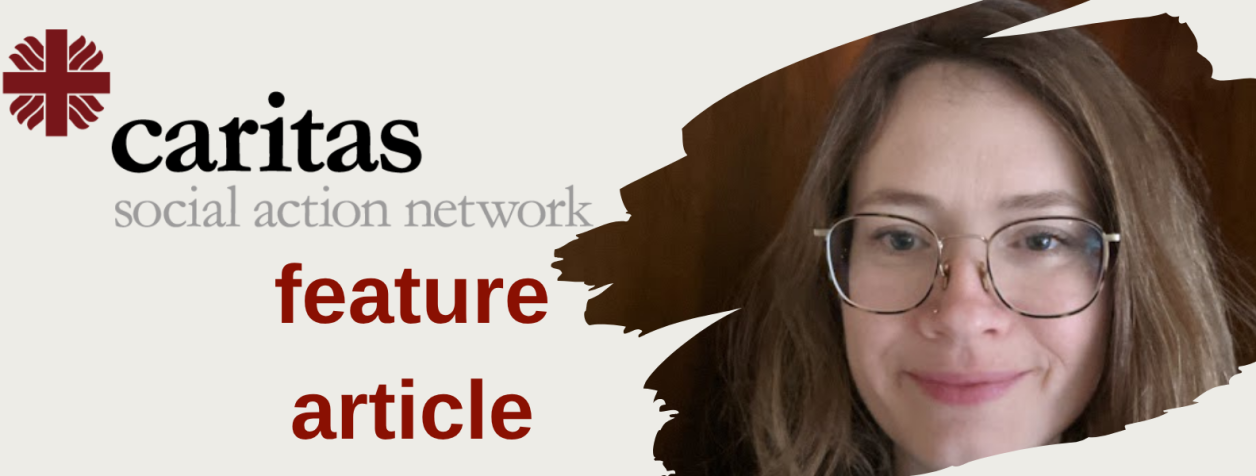
David Byrne, Communications and Programmes Officer (DB) speaks with Fiona Ranford (FR), Senior Migration Officer at CSAN (Caritas Social Action Network), about her role, the challenges and hopes around migration, and the particular contribution of faith-based organisations today.
Fiona’s Role and the First Six Months at CSAN
DB: Fiona, to start us off, could you say a bit about what you’ve been doing over the past six months at CSAN – what your role entails and what some of the highlights have been?
FR: My role at CSAN is Senior Migration Officer. Broadly, that means working with the network to reflect on how we respond to the lived realities of migrants and refugees in the UK, both through practical solidarity and by developing a prophetic Catholic voice in the public arena.
With the support of the Gubay Foundation, this includes a focus on migrants who face labour exploitation under the category of modern slavery. One of the first things I did was to continue the informal networking that had been happening among diocesan organisations working on modern slavery and trafficking.
It became clear very quickly just how much knowledge and insight exists in the network, and the value of facilitating that sharing of expertise.
A real highlight for me has been seeing how generous people are in those spaces in sharing both the difficulties they’re facing and offering support to one another – whether through offering 1:1s to share experiences with each other or sharing of resources to be reused by other groups.
In fact, this generosity has been visible in all my areas of work at CSAN – in the time people have given to organising and participating in the collaborative innovation programme, and in the many hours spent together during the Migration Alliance in-person meeting working on building the groundwork for a shared strategy.
Background: Working in Solidarity with People in Detention
DB: Before we come to how CSAN speaks publicly on these issues, could you give a bit of your background before joining CSAN – especially your work around migration and detention, and the kind of expertise you bring into this role?
FR: Before CSAN, I worked for a network of groups acting in solidarity with people in immigration detention across the UK. That role had much in common with this one, but with a greater focus on training and education around practical solidarity. Many volunteers in these groups were deeply rooted in their Christian faith and found that it moved them to act and to stand alongside people in detention.
One thing I experienced through meeting people in immigration detention is that it forces us to confront the lived realities of people at the sharpest end of our immigration system – with those whom the government want to expel from the UK. Successive governments and media narratives tell a story that frames these people as worthless – or worse – as dangerous and therefore disposable.
It is a narrative that relies on imagined categories of the ‘good’ versus ‘bad’ migrant, the ‘genuine’ migrant and the one who ‘cheats’. But when you speak with people in immigration detention, these categories are quickly exposed as redundant characterisations that obscure a deeply dehumanising immigration system.
I believe the church can play an important prophetic role here, not only by affirming the UK’s responsibility to offer protection for those escaping the worst kinds of harms, or a pragmatic need to invite in those who can work in sectors that rely on migrant labour, but to bravely articulate a vision for a society built on Gospel values and on Catholic Social Teaching. In such a society, the right to a dignified life is not granted according to where someone is born, how much they earn, or how they arrived in the UK.
It must do this in the face of fear-mongering about the danger of the ‘other’, and stories about the causes of extreme inequality in the UK, which point the finger at migrants, rather than those who decide how resources are distributed.
Christian Nationalism and the (Mis)use of Christian Symbols
DB: We’re increasingly seeing (not just in the UK but across the world) a grasp for the Christian meta-narrative to talk about migration and related issues. There are very different directions this can take, including what some describe as the rise of Christian nationalism, some forms of which can adopt quite a negative view of migration. How do you understand this movement?
FR: I’d want to choose my language carefully here, but I can say a few things.
What we’re seeing is the mobilisation of Christian symbols, festivals and language in service of a very well-funded, ethno‑nationalist project. Within this movement, “Britishness” is associated with (but not limited to) being born in the UK, with whiteness and with a set of ideas described interchangeably as ‘Christian’ and ‘Western’. It doesn’t take much digging to see how far these ideas take us away from gospel values – Helen Paynter calls them ‘thin theologies’.
These ideas are framed in opposition an ‘other’ who is often Muslim and is described as a threat. In practice this is a movement that uses the language and imagery of christianity to try and gain credibility for Islamophobic and anti-migrant rhetoric. In doing so, it gives sanction to violence as well as ever-more authoritarian forms of governance.
The reason these ideas can gain traction is that they are offering something that many of us are hungering for across the UK – a sense of belonging to something bigger, a story about why life is as hard as it is, and why things seem to be getting harder for the majority. And yet this is a story that stokes division instead of addressing the root causes of discontent.
So there are two major challenges we need to take on when confronted with Christian nationalism:
First, to resist the appeal of a fearful and divisive politics that pits people against each other. Instead, we need to clearly and unapologetically speak about the radical inclusivity shown by Christ. As Pope Leo XVI writes, “[the Church] knows that her proclamation of the Gospel is credible only when it is translated into gestures of closeness and welcome.”
In such a climate of hostility and suspicion of the other, fear can pull us away from this biblical vision towards a suspicious and impoverished pragmatism. To combat this as Christians, we must be symbols of unity and togetherness. Concretely, this might look like meeting with our Muslim neighbours and showing up for them when they are persecuted.
Second, we need to fill the vacuum of economic analysis which these authoritarian movements thrive in. This requires that we work together to understand experiences of isolation and poverty and their root causes – Catholic Social Thought and Practice equips us brilliantly for this task.
As Pope Leo explained recently, “there is no lack of resources at the root of disparities, but the need to address solvable problems related to a more equitable distribution of wealth, to be achieved with moral sense and honesty”. We need to understand the decisions around the extraction and allocation of wealth and resources that are being made day to day that manifest in a world of extreme inequality from the global down to the local level – this is a challenge of discernment and political education!
Signs of Hope: A March for Solidarity
DB: Many people feel short of hope and optimism right now. You’ve been at several public events recently. Could you talk about signs of hope you’ve seen – perhaps beginning with the big march you attended in March?
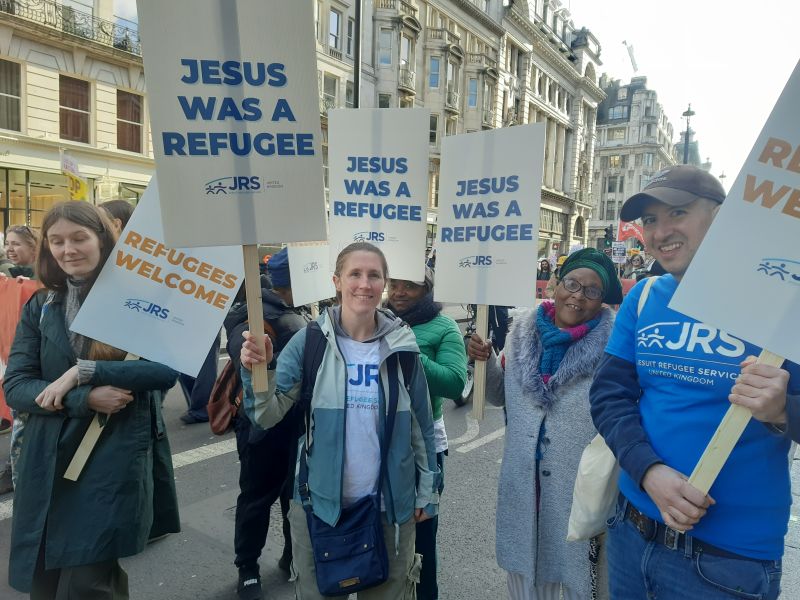
FR: The march in March was incredibly moving. I went in my capacity as a representative of CSAN to show support and to understand more about who was marching and why. I joined our colleagues at JRS UK marching in the Christian bloc.
The aim was to demonstrate that the vast majority of people do not want to live in a society driven by fear of “the other” – whoever that other is cast as. Instead, people want a society where we stand in solidarity:
- with those who are scapegoated, and
- with those who are struggling, even when their struggles look different from our own.
Seeing hundreds of thousands of people making such a visible statement for hope and unity was incredibly powerful – especially when so many media narratives focus on division and fear, and on encouraging people to be afraid of one another.
What Faith-Based Organisations Bring
DB: What specific role do you think faith‑based organisations play in this conversation?
FR: In the run‑up to the march, it became very clear that there was a strong desire for faith‑based organisations to be present and visible. People recognised the moral weight that faith leaders and communities carry.
It surprised me how explicitly people named this, and how uncomplicated it seemed to them: there was a widespread sense that faith groups have an important, distinctive role here.
Christians are present in every part of society – in trade unions, community groups, , in activist organisations and in charities. But at the march there was something particularly powerful about having a clearly identifiable Christian presence,that unashamedly articulated Christ’s love for the stranger, the outcast and those on the margins.
It was fantastic to meet with other churches and ecumenical groups like “A Better Story”, who coordinated a Christian block at the march. They organised a beautiful church service beforehand which was so full that they had to stop letting people in!
Looking ahead, one of the questions we’re asking together is: how do we move beyond just saying “don’t be divided, don’t hate your neighbour” to also telling a compelling story about people’s economic reality that leads towards inclusion, harmony and flourishing communities of love?
There are profound resources in the Gospels and in Catholic Social Teaching on the economy that kills, and on why people are experiencing life as so difficult. We need to bring that analysis more clearly into public Christian witness.
Catholic Social Teaching, Power, and the Gospels
DB: Catholicism has always claimed to be a holistic presence in people’s lives. Since Vatican II, that’s been made even more explicit – the Church addresses all people, not only Catholics.
We’re seeing a Catholic voice which is truly “catholic” in the sense of according to the whole: not addressing just the faithful but concerned for the welfare of the entire world.
We see this, for instance, in how Pope Leo has confronted attempts to weaponise Christianity in politics – using Christian language to justify some of the most blatantly anti‑Christian things. More broadly, there’s an ongoing contest over what Christianity means when it’s aligned with power. Power itself isn’t bad, but we are seeing very different ways in which people appeal to Christianity to justify their use of power.
Scholars often point to the Gospel of Luke as offering a particularly sharp critique of the misuse of power and wealth and a strong advocacy for the marginalised – including women and those on the periphery. Luke knew he was addressing people who were likely to hold power and wealth, and he wanted to present a deeply humanising portrait of those who had been disempowered or made poor by the powerful of the age.
All of this is threaded through Catholic Social Teaching, and I think we’ll see that voice sharpen further in the coming years. It’s encouraging to be able to locate what we’re doing at CSAN very firmly in that gospel and social teaching tradition.
FR: Yes, and I think as churches are drawn – almost forced – more into the public arena with the rise of Christian nationalism, there is an opportunity to dig deeper: to prayerfully return to the Gospels, to Catholic Social Teaching, and to ask what they demand of us now. I’m really looking forward to our time together in June, where the CSAN team will facilitate further discernment around these signs of our times.
The Church is being called upon urgently to speak truth to power. That’s both a gift and a challenge. We need to meet this moment boldly, without shying away from the conflicts and discomfort that might come with it.
We’re very conscious at CSAN of the mandate we have as an agency of the bishop’s conference to be a prophetic part of that public conversation. It’s both humbling and demanding.
A Shared Call to Courage and Solidarity
DB: I think many of us working in this space feel that tension: the privilege of having a voice, and the weight of using it well, especially when it might bring us into conflict with powerful interests.
In that sense, I find the witness of Pope Leo very encouraging. To see someone in that role take on the cross of articulating the gospel without making concessions to the powerful gives courage to those of us sharing that mission in smaller ways.
It underlines the need for us to be courageous, to support one another when we take risks, and to build a community that is genuinely rooted in love, solidarity, and a truthful vision of what the Kingdom of God might look like in our time.
FR: Yes. And that, for me, is the hopeful note. When we support one another in taking those stands – when we refuse to let others be scapegoated or dehumanised and instead act in solidarity – we begin to embody that vision, even in small, imperfect ways.
That’s where I find hope: in the communities, marches, parishes and networks where people are quietly and not‑so‑quietly trying to live out that call together.
DB: That feels like a very good place to stop.
FR: Yes – and also to begin afresh.