In teaching us charity, the Gospel instructs us in the preferential respect due to the poor and the special situation they have in society: the more fortunate should renounce some of their rights so as to place their goods more generously at the service of others. Pope Paul VI, Octogesima Adveniens (1971), n.23.
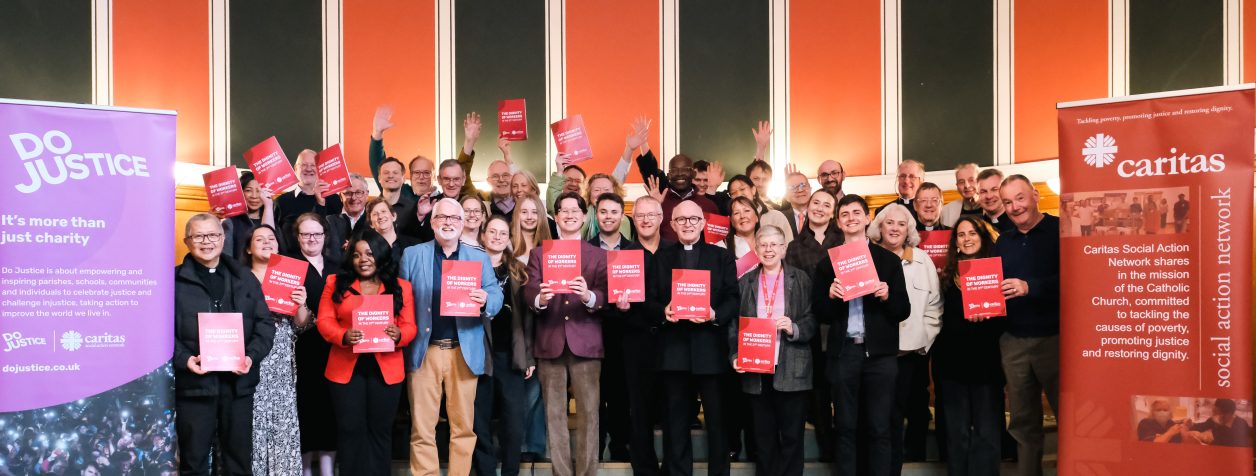
Caritas Social Action Network is proud to launch its latest publication, Dignity of Workers in the 21st Century.
At a time of rapid economic and technological change, the publication explores the challenges and opportunities facing workers today through the lens of Catholic Social Teaching. It reflects on issues including low pay, insecure employment, automation, migration, artificial intelligence, social care, and the changing nature of work, while reaffirming the inherent dignity of every person and the value of meaningful work.
We see this publication as part of the Church’s wider preparation to receive the anticipated major social document of Pope Leo XIV, Magnifica Humanitas (“Magnificent Humans”). According to reports, the encyclical will focus specifically on the impact of artificial intelligence on people and working conditions, representing an important effort to renew Catholic Social Teaching for the AI era.
Drawing on the Church’s rich tradition, including the teaching of Pope Leo XIII, St John Paul II, and Pope Francis, the publication calls for an economy that places people before profit and promotes participation, solidarity, and the common good.
We are also pleased to feature contributions from an outstanding group of writers and thought leaders, including Maria Exall, John Battle, Jon Cruddas, Clifford Longley, Amy Daughton, Charles Wookey and Raymond Friel.
Dignity of Workers in the 21st Century is now available to read and download.
Now in its third cohort, the Aspiring Leaders’ Programme recently gathered for its second residential at the tranquil retreat setting of the Royal Foundation of St Katharine in London. The focus of these days together was the interpersonal realm. For many of us working in the charity sector — often characterised by fast-paced and demanding environments — the residential offered a welcome opportunity during the season of Lent to step back from the pressures of daily work and enter into a space of reflection, learning and renewal.
Renewing Relationships in the Season of Lent
As our time together began, Raymond Friel, CEO of Caritas Social Action Network, offered a thoughtful reflection on the traditional pillars of Lent: prayer, fasting and almsgiving. He provided a relational interpretation of these practices, encouraging us to move away from viewing them primarily as acts of self-denial and instead to see them as pathways for renewing relationships — with God, with one another, with ourselves and with the wider created world.
This perspective was deeply inspiring. It presented a more holistic and integrated understanding of Lenten discipline, one that resonates particularly in a contemporary context where relationships are often treated as optional, increasingly mediated through digital means, or at times undervalued altogether.
Relational Leadership in a ‘White Water World’
We then benefited from a powerful masterclass in charity leadership from Patrick O’Dowd, Director of Caritas Salford. His session, Relational Leadership in a White Water World, was both challenging and energising. Patrick emphasised the central importance of attending to the emotional and relational dimensions of leadership, encouraging us to become more attentive both to our own emotional responses and to those of the people with whom we work.
One insight that has remained with many of us was his observation that while people may forget what a leader said or did, they rarely forget how that leader made them feel. Patrick spoke movingly about the responsibility leaders have to foster cultures of belonging in the workplace, and about the inseparable connection between what we achieve and how we achieve it. Organisational objectives cannot be pursued at the expense of the relationships that make their fulfilment possible.
He also challenged unhelpful stereotypes of leadership. Leadership, he suggested, is not simply about saying “yes”. At times it requires the courage to say “no”, “not yet”, or to ask discerning questions that empower others to contribute their expertise. Leadership is therefore not synonymous with personal mastery of every issue, but with recognising and nurturing the talents and strengths of others so that teams can flourish together.
Importantly, Patrick reminded us that leadership is not solely about responding to crises or solving problems. It is also about joy. Taking time to acknowledge shared achievements and to celebrate progress is vital for sustaining motivation and fostering healthy organisational cultures.
Transformational Leadership and Shared Responsibility
Our second facilitator, Stephanie MacGillivray, Senior Press Officer at the Catholic Bishops’ Conference of England and Wales, offered practical and reflective insights into transformational leadership. Her session encouraged participants to consider their own leadership journeys and to discern pathways for growth and development.
Steph invited us to reflect on the tension between power and values, asking whether we are more motivated by the power that positions can bring or by the values that should guide our leadership. She stressed that authentic leadership requires accountability not only to those higher in formal organisational structures but also — and perhaps especially — to those directly affected by our leadership decisions.
This perspective encourages a shift away from viewing leadership as a rigid hierarchy and towards understanding it as a network of relationships and shared responsibilities. Leadership may be exercised in different ways across a team, depending on the gifts and competencies present. Steph concluded by guiding participants through a reflective assessment of their own transformational leadership strengths, focusing on key competencies such as modelling the way and constructively challenging established processes.
Trauma-Informed Leadership and the Culture of Belonging
Our final facilitator, Nikki Dhillon-Keane, a trained psychotherapist and Head of Service at Caritas Safe in Faith, offered a deeply thought-provoking exploration of trauma-informed leadership. Building on earlier discussions, Nikki outlined a fourfold typology of leadership: structural leadership rooted in formal authority; thought leadership expressed through ideas and communication; beacon leadership centred on identifying and nurturing the gifts of others; and moral leadership grounded in the consistent embodiment of personal values.
Nikki proposed that effective leadership today requires an awareness of how trauma shapes individuals and organisational cultures. Trauma, she explained, is not defined solely by events but by their lasting impact on our capacity to feel safe, connected and able to engage fully in our work. Creating environments characterised by safety and belonging is therefore essential not only for personal wellbeing but also for organisational effectiveness.
She explored how trauma responses extend beyond the familiar “fight or flight” paradigm to include patterns such as freezing, fawning and flopping (playing dead). These responses are not conscious choices but protective mechanisms activated by the nervous system. Understanding this can help leaders cultivate compassion, patience and emotional intelligence in their interactions.
Nikki also emphasised that trauma is frequently relational in origin, highlighting the profound influence that relationships have on both harm and healing. Drawing on the work of Carl Rogers, she suggested that leaders can help foster healthier workplace cultures through empathy, authenticity and unconditional positive regard — choosing to recognise and affirm the inherent dignity and goodness of those they lead.
Continuing the Journey of Formation
As the residential concluded, many participants were left reflecting on the depth and richness of the experience. It combined a strong sense of belonging and gentle accompaniment with a meaningful challenge to grow as leaders — responding faithfully to God’s grace and recognising that the quality of our relationships is central, rather than secondary, to the effectiveness of our work.
Participants now look ahead with anticipation to the next Aspiring Leaders’ residential in June, which will focus on exploring the organisational realm and continuing this important journey of leadership formation.
I started volunteering for Caritas Shrewsbury’s The Well Project 7 months ago.
I volunteer weekly at the Women’s Group which provides a welcoming space for refugees and people seeking asylum to come together for English conversation and a range of activities, such as craft, sewing, knitting, cooking and exercise, as well as providing information and orientation for life in the UK.
Volunteering with Caritas Shrewsbury’s Well Project has been a really positive experience for me – the opportunity to connect over shared interests and activities, to have everyday conversations and enjoy each other’s company, seem like small but significant acts of normality in the unpredictable and stressful situations that many refugees and people seeking asylum are dealing with.
Our sessions are busy and fun; skills, experiences, words, traditions, and beliefs are shared, and we all learn from each other. I know so much more about the countries and cultures of the women who attend the group now, along with some great kitchen hacks! I would like to feel that we are helping to make good Manchester memories for the new lives that the women and their families are building here.
I enjoy being part of the Caritas Team at The Well Project, the other volunteers are amazing; so dedicated, friendly, and supportive of each other. The Caritas worker who manages the sessions is excellent – she makes sure that the voices of the women are heard, and she is enthusiastic and encouraging of the volunteer team.
When I retired, I was keen to do some volunteering in my local community. I am very glad to have found a role with Caritas, I feel that I have the opportunity to put my faith into action at The Well Project; the principles of social justice and Christian love are alive and well in what we are doing and that is important to me.
I joined the Catholic Marriage Advisory Bureau, later to be called Marriage Care, 33 years ago as a Marriage Preparation Facilitator and two years later I became a counsellor. The training, love and care I received during what were some of the most difficult times in my life really helped me to be the person I am today.
I can say we are a family of love all striving for the same goal which is to help couples prepare for Marriage and to nurture them though their own journey if they have any problems.
As one of the Trainers for Marriage Preparation I can say we work together to ensure that new volunteers get the best training possible and that they are well prepared to deliver to the highest standard – ensuring that God is at the centre of all we do.
At the heart of my various roles in Marriage Care is my belief that the vows we undertake on the day of Marriage begin a lifelong journey. After 52 years of Marriage with the loss of my young son aged 16, couples need to understand that the promises they make to each other are not fickle but a light burning brightly, when the light flickers and they cannot resolve differences we – Marriage Care – are there for them, we always welcome them to the family of Marriage Care.
When a couple say thank you for a lovely day it makes me happy, when a couple say they want to be a volunteer because Marriage Care helped and they want to give something back or when I get a letter from a priest saying that the couples are very happy with their marriage preparation day I thank God for giving us the gift of love.
Marriage Care has taught me patience, kindness, tolerance, acceptance and love.
Glenda is one of many volunteers with Marriage Care. To find out more about their work, visit here.
I began volunteering with Caritas Shrewsbury about six months ago, working with The Well Project based at St Aidan’s in Wythenshawe. Having previously volunteered as an English teacher with a range of students, I was looking for a project that not only focused on language learning but also fostered community cohesion and a sense of belonging.
I feel I have found this with the women’s group under the guidance of Lana.
Working with the women’s group has been a truly enriching experience. Through activities like craft, cooking, and sewing, we try to create a welcoming space where women can practice English in a natural and supportive environment.
More than just language skills, these sessions are about connection, confidence, and mutual learning. I’ve gained so much from listening to their stories—insights into different cultures and perspectives on resilience, and the strength of these women in overcoming challenges. I have also improved my cooking skills!
Although I am no longer a person of faith, my mother was a deeply committed and active Catholic. Even after her death several years ago, she remains my moral compass. Helping others was part and parcel of her life, and in many ways, my voluntary work is an unspoken thank you to her—for the love, guidance, and values she instilled in me.
My voluntary experience with Caritas has reinforced the power of compassion, understanding, and human connection. It has shown me that even small acts of kindness—offering time, a listening ear, or a shared moment—can make a profound difference not just to the recipient but also to your own sense of connection.
Helen volunteers with the Well Project which is an initiative of Caritas Shrewsbury. Find out more here.
Why and how did you begin volunteering as a member with the SVP?
I joined SVP back in 1983 to put Catholic Social Teaching into practise and faith into action. I joined a local conference and set up another. Ozanam’s teaching plus St Vincent have been a key inspiration.
What difference does it make to your life?
It has given me a real purpose and focus in my life.
Are there any inspiring stories that will always remain with you?
Many inspiring stories both here in England and Wales, and overseas with our twins. The latter has been key in giving the UK a reality check and benchmark on poverty. Having been the SVP country ambassador for our India twins, I have seen many small projects set up, especially for women in India.
Do you see any link between your volunteering and your faith?
Yes, without doing the volunteering through the SVP, where is faith in action?! Practical action inspired by and supported by prayer, Bible study and Mass and other devotions – Mother Teresa examples a constant reminder!
I first discovered Caritas St Joseph’s (CSJ) about 15 years ago, while looking for a day centre for my daughter Natalie. Caritas St Joseph’s was highly recommended by one of Natalie’s former teachers, and I can see why: it’s a unique place centred around core principles of love, care, kindness and commitment, all of which are shown by the wonderful staff who work there. It really feels like a family.
Having seen Natalie blossom as a student at CSJ, I thought it right to contribute to the centre’s work by sharing my own knowledge and experience, so 14 years ago I began volunteering there once a week.
I started by assisting at Reception, which helped me to learn about the students and their lives, forming strong relationships with both them and staff. A year later, I moved into the ‘Stage in Making’ class, helping students to make props, as well as supporting ‘Music Recording’ sessions where students prepared a show to perform at the end of term. I have also learnt British Sign Language, and enjoy practising with Natalie at home.
I have formed many meaningful friendships with students during my years at CSJ. I became very good friends with Francis, the first student I ever met back when I initially came to view the centre. He became a close family friend, sharing my husband and daughter’s interest in football. Francis passed away last year, and we miss him very much.
Volunteering at CSJ is also immensely rewarding. One student I have worked with over the past 10 years used to only be able to use one hand; now, he has made incredible progress and can use both hands. I also bonded with another student, who is a non-verbal wheelchair user; after many months of coming to my music class, he gave me a big smile and put his hand out to say hello. Moments like these are the reason I volunteer at Caritas St Joseph’s.
My faith strengthens me in my volunteering, and enables me to support the students at Caritas St Joseph’s. Helping at the centre is a pleasure, privilege and an honour. I enjoy every minute, from the moment I walk through the front door.
Kay volunteers with Caritas St Joseph’s which is an initiative of Caritas Westminster. Find out more here.
I joined the Catholic Church in 2006 from a lifetime of atheism. I had at that time been volunteering in conservation and countryside management for over 25 years and continued while assuming minor roles in our parish until the onset of covid in 2020. It was at this time that I started working with Liz Wills from Caritas distributing food parcels to needy families in the local area. When we were approached with the idea of operating a Pantry I got involved in setting it up and when it opened I took on the role of meeter/ greeter and refreshment maker.
In contrast to my former years of volunteering I was now working directly with people, most of whom are financially or socially disadvantaged. This experience, particularly meeting refugees and asylum seekers, has led to a much greater awareness and insight into the challenges faced by my ‘neighbours’ in daily life. In these circumstances I can try to fully live the gospel values taught by Jesus eg embracing love of poor and overlooked and accepting the stranger. My faith is strengthened by the knowledge of the good that can be achieved by living these values and by evangelising through good works.
I find the relationship I enjoy with our members and with the wonderful team of volunteers very rewarding and affirming of goodness and grace which is around us. Working with the team rewards me personally with friendship and support in my own life, we are a family. And of course I have found friendship with the people we serve.
We hear some heart wrenching stories, everyone whom we serve faces difficulties in their lives but it is good to know that in some small way we can help by offering a listening ear and sometimes give practical advice and assistance.
It is always good to hear of some positive changes in someone’s life, particularly for example when asylum seekers obtain a visa and a home to move into where they can start the long journey of settling into life in a new country. These are people of great resilience and determination who, despite the challenges ahead of them I’m sure will flourish in their new lives and bring much to our country.
In summary I have found in this work a new sense of purpose and belonging in my retirement years and would say that I receive more than I give.
David volunteers with the Hitchin Pantry, which is an initiative of Caritas Westminster. Find out more here.He has recently won a Caring Award with the ‘North Herts Heroes 2025,’ for his support of isolated individuals over the past three years. Watch a video of David and the rest of the Hitchin Pantry team in action here.
Why and how did you begin volunteering as a member with the SVP?
I joined the SVP in 1977 after I met a Civil Service psychologist during a promotion selection board at work. He asked me if I got involved in any of the social welfare activities of the Catholic Church. I had to admit that I didn’t (A bit like Frederic Ozanam being challenged by the students at the Sorbonne University to “show us your works”, perhaps?). Anyway, I wondered afterwards what I could – and should – do about this? I thought of the old gentleman who I used to see when I was a little kid, standing quietly in our Church porch after Mass every Sunday, holding out an SVP collection box. I thought of the collections we used to have in school for the SVP a couple of times a year, for which Mum and Dad made sure I had some money in my glove when I went off to school that morning. I thought of all the “Jack-the-lads” I knew in the 6th form at school who enjoyed the camaraderie of the school rugby team and various youthful escapades and also something I only found out years later, because they never spoke about it – the fact that (unlike me) many of them were also members of the school’s SVP Conference. They were giving up their Saturday mornings to visit elderly and lonely people in the local area, to bring them a little happiness and companionship . . . and I had the answer to my question . . .
What difference does it make to your life?
A lot! It has given me:
a greater sense of purpose in life
the opportunity to offer my abilities for the service of people less fortunate than myself, and to develop as a servant leader.
the privilege of meeting so many wonderful people, both within our Society and among the people we serve.
the great joy of knowing that I am part of a loving and world-wide family of like-minded people, united in a common vocation of loving service to Our Blessed Lord and His friends in need.
Are there any inspiring stories that will always remain with you?
I remember the final day of our SVP National Meeting in 1984, which that year took place in the Villa Marina in Douglas, I.O.M. Archbishop Derek Worlock of Liverpool was the Principal Celebrant at our National Sunday Mass. I will never forget his homily that day. That this was the year of the national miners’ strike. Many mining communities up and down the country were suffering real hardship and were, in many cases, dependent on their families and local charities – the SVP prominent among them – for food, fuel, and other household essentials. The Archbishop spoke of the labourers in the vineyard who the landowner hired at the eleventh hour, as no-one else had given them any work that day. By then they must have been desperately worried that they would have no money with which to buy their families anything to eat. The landowner took pity on them without humiliating them. He treated them as the equals of those who had worked for him all day. He restored their self-respect, and he made sure that their and their families’ needs were met. The Archbishop described the landowner as “an apostle of the eleventh hour”. He went on to say that that this was exactly what the members of the SVP Conferences and all those at Mass in the Villa Marina in those mining communities were as well. We are here to help anyone in need regardless of who they are or what they are, our help is offered freely to anyone without judging them, and we are here for anyone in need at any time – even when they may think that all other hope is gone. An Apostle of the Eleventh Hour – what a wonderful way to describe a member of the St. Vincent de Paul Society!
Do you see any link between your volunteering and your faith?
Most certainly. Quite simply, Our Blessed Lord Himself has said: “Whatever you do for these, the least of My sisters and brothers in need, you do it for Me.” (Matt. 25:40). That sums up everything that our shared Vincentian vocation is all about.
Volunteering was always something I knew I would do following retirement. Having worked with CAFOD for over 15 years, I was drawn to working with disadvantaged, marginalised and vulnerable groups.
The first place I looked was my local Windsor Christian Action in 2006 – operated by Churches Together in Windsor. There was an opportunity to work with homeless people, serving hot dinners once a week to begin with, and later helping with various ‘odd jobs’ where necessary.
In 2011, I joined RENATE (Religious in Europe Networking Against Trafficking and Exploitation). I knew that Caritas Westminster had opened Caritas Bakhita House – a safe house for survivors of trafficking – in 2015, so I contacted them to offer my services. I met with Karen and Anna for an initial chat, offering to help in whatever way was best for their guests – perhaps teaching English, Computing or simply accompanying the women to their appointments.
Volunteering at Caritas Bakhita House has made a huge difference to my life. Working there, I interact with women from different countries, cultures, customs and faith traditions. This is both humbling and inspiring. Humbling, because their stories of abuse, trauma and overcoming difficulties are what I can only begin to imagine, and have made me realise just how much my own experience growing up in rural Ireland was one of privilege, safety and love. And inspiring, because I am frequently in awe of the resilient women who overcome incredible suffering through the care and love shown to them at Bakhita House, and go on to live life the full.
The stories that I hear from women who have escaped abuse and exploitation – often from childhood – are always heartbreaking. One can but listen, offer hope, comfort and walk alongside them with a compassionate heart. Not being able to ‘solve’ the problem or take away another’s pain is not just a challenge, but a sadness for me. However, I believe in the power of prayer and the response it evokes from a loving, compassionate God. To quote Alfred Tennyson, ‘More things are wrought by prayer than this world dreams of,’ and I find reassurance when I pray for those who struggle to find hope, peace or fulfilment in their lives.
Faith is so much a part of my daily life, especially as a religious. It shapes why and how I do volunteer work. My inspiration comes from the example of Jesus and his radical message of inclusion, particularly inclusion of those whom society rejects or fails to support. The principles of Catholic Social Teaching also inform my life, from the dignity of every human person to solidarity and the common good. We have a beautiful world, a world of goodness created by God, and it is incumbent on us to promote and share its beauty and goodness. That reinforces my faith, and it is also nourished by my volunteering work.
Sr Mary Patricia volunteers with Caritas Bakhita House which is an initiative of Caritas Westminster. Find out more here.
We use cookies to ensure that we give you the best experience on our website. If you continue to use this site we will assume that you are happy with it.