

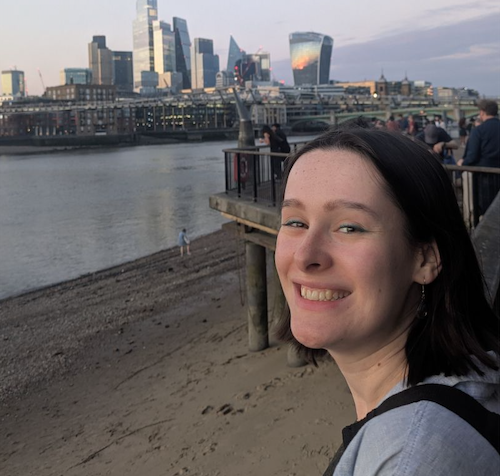
David: Thanks so much for taking the time to chat. This interview is a chance for the CSAN network to get to know you a bit better – who you are, what’s shaped you, and what you’re hoping to achieve in your role here. To start us off, could you just tell us a bit about yourself and what attracted you to this role at CSAN?
Erica: It does feel a bit like I’m back in my job interview!
My background is in youth climate activism. That was my way into both politics and thinking about faith and politics together. I started talking about climate action in my church while I was involved in the climate strikes, and that led to conversations at a local and regional church level about how we develop our environmental work, talk about climate justice, and root that in our theology.
That experience at quite a young age really shaped me. It gave me a grounding in seeing my faith and politics as deeply intertwined. For me, faith isn’t something that can be siloed away from how we structure society, relate to one another, or think about power and hierarchy. The Church is woven into those structures, and I think there’s so much in the Bible that calls us into engagement with the world, not into being a backward, disengaged, or apathetic Church.
All of that eventually led me to apply for an internship with the Joint Public Issues Team (JPIT) after university. It felt like such a strong alignment of my values. I was able to work on projects that overlapped a lot with CSAN’s concerns – including a project on AI, justice, and faith, and how churches might respond.
I’m also very interested in ecumenical relationships. I’ve previously worked with the Methodist Church, the United Reformed Church, and the Baptist Union, but I grew up in the Church of England. So I’m coming to CSAN as someone who isn’t Catholic, but who is really excited about how different denominations can work together, rather than each retreating into their own separate spheres of influence.
Looking ahead in this role, because of my climate background I’m especially keen to help develop CSAN’s work on the environment – particularly around integral ecology – and make sure it’s naturally integrated across our advocacy priorities. I’d love to see us talking about ecology not as a standalone issue, but as something that intersects with everything else we do, just as faith intersects with every area of life.
Church, Civic Society, and Political Life
David: You’ve studied history and clearly thought a lot about institutions. How do you see the changing relationship between the Christian churches in the UK and political life? To what extent do churches still have a voice and influence, and where do you see that relationship heading – both positively and potentially problematically?
Erica: I think the history of the Church and its institutions is crucial to understanding where we are now. There are aspects of that history we should celebrate – especially our involvement in social justice movements. For example, I’ve written about the primitive Methodist movement and how it took pride in its social justice heritage. People often point to the abolitionist movement as a key example.
But as we’ve begun to decolonise our histories, many have rightly highlighted the Church’s historic ties to the slave trade. That includes financial records and direct entanglement in the trade. Alongside that, there are other deep structural issues that we can’t ignore, such as systemic racism.
For me, growing up in the Anglican Church and now working within the Catholic context at CSAN, I’ve had to wrestle with how integrated the Church should be in civic and political structures. We can see this in the debates on the future of the House of Lords and the number of its members who represent the Church as one example.
On the other hand, we can see in some more secular contexts that separating faith from public life can create its own injustices, including serious Islamophobia. So there isn’t a perfect model.
Given the power the Church still holds, I think we carry a huge responsibility. That’s not so much to speak “on behalf of” marginalised people, but to elevate and centre their voices inside the Church and in wider society. We can’t pretend the Church is just a cosy place we go to escape the world. Because of our history – both the good and the bad – and because we still wield influence, we have a duty to use it for the good of others.
Faith, AI, and Moral Leadership
David: CSAN has been exploring the Church’s role in responding to the rise of AI, and you’ve already been involved in our Magnifica Humanitas reading group. What do you think the role of the Church – and of CSAN and our network – should be as AI becomes ever more embedded in people’s lives and in institutions?
Erica: I was so excited when I saw that the Pope’s first major text on AI came out just as I was working on those themes at JPIT. I was really impressed by the level of thought leadership being shown.
Since joining CSAN, I’ve done a lot of reading of encyclicals and Catholic documents more broadly. There’s so much there that’s relevant, not just for AI, but for any technological change we face in future.
One line of argument that really stands out to me is that we shouldn’t position ourselves as anti-technology. The Church has, at times, been slow to adopt technology and that can leave us behind. But technology itself isn’t inherently bad – you can see that historically, from the printing press onwards. I’ve really taken to the idea that instead of being anti-tech, we need to become more human. That means nurturing our compassion, deepening our commitment to social justice, and being alert to new “hidden injustices” that are built into new technologies.
There’s also an opportunity here. Many people are increasingly disillusioned and unsure about what is true or real. Our faith – and other faith traditions too – offer a grounded sense of truth that can help us discern how technology should be used. We can affirm that tech can be used for good while also being clear about harmful uses, and willing to challenge them.
So I see the Church’s role, and CSAN’s in particular, as providing that moral and theological grounding, helping people to discern wisely, and speaking up when AI and other technologies embed injustice.
Young People, AI, and the Dignity of Work
David: One of CSAN’s key advocacy priorities is the dignity of work, especially for young people – something that intersects very strongly with AI and wider economic changes. You’ve been reading some of CSAN’s work on this. What are your initial reflections, and where do you see this workstream developing?
Erica: One thing that really strikes me is how often young people’s voices are not centred in conversations about youth employment, even when the conversation is supposedly “about” them.
As someone who has been involved in youth activism, and who is still under 25, I’ve felt that tendency first-hand, where young people’s contributions get dismissed as naive or uninformed. That’s incredibly dangerous, especially now. Young people can often see new possibilities and ideas in ways older generations struggle to, simply because they’re closer to emerging realities.
I’m not saying that all older people’s ideas are bad, or that everything young people say is right. But I do think many reports and articles overlook the need to have young people leading the discussion, not just being discussed.
CSAN has a real opportunity here. Through our work with young leaders and initiatives like the Youth Alliance, we can ensure young people are genuinely leading strategic work and advocacy on youth employment and AI. That means moving away from talking about young people in their absence and instead creating spaces where they set the agenda.
This is also a challenge within church institutions, where young people are underrepresented in leadership. You see it in decisions like the closure or defunding of youth-focused bodies and programmes across civic society. When those spaces diminish, young people lose vital routes into public life.
So for me, a key priority is integrating young people themselves into the conversation and into leadership on these issues.
Ecological Justice and Integral Ecology
David: You mentioned your climate justice background. How do you see ecological justice fitting into CSAN’s wider work and network?
Erica: One of the most exciting things so far has been hearing about all the projects happening at diocesan and local levels – work with young people, people experiencing homelessness, those living in poverty, and many others. CSAN isn’t always on the front line of that work, but we’re closely connected to it, and it’s incredibly inspiring.
Because of my climate background, I’m especially interested in working with diocesan environmental leads to develop CSAN’s work on integral ecology as a cross-cutting theme. There are so many natural points of connection – for example, the environmental impact of data centres, or the way heatwaves and extreme weather in the UK will affect food poverty and the most vulnerable.
With the pace of climate change, these issues are no longer abstract or distant. They’re being felt here and now in England and Wales, especially by people already on the margins. I think CSAN is well-placed to highlight those interconnections between ecology, poverty, inequality, social cohesion, and peace.
We may not always be the ones delivering frontline services, but we can offer a broader vision, tell the stories, and point towards action. That kind of prophetic work feels really important.
Professional Development and Hopes for the Role
David: CSAN is committed to your professional development as a young policy and public affairs professional. What skills or areas are you hoping to develop during your time here?
Erica: In my previous role I was more communications-focused, which I loved – especially the creative side of breaking down complex issues in accessible ways.
Here, I’m really looking forward to strengthening a slightly different set of skills. That includes returning to my research roots from my degree: staying up to date with policy reports, analysing them, and then translating them into something useful and usable for the network.
I’m also keen to develop the relational side of the work by building connections across the network, listening carefully to what people and organisations need, and figuring out how CSAN can best serve them in their advocacy and campaigning. That means developing people-centred policy strategies, grounded in real stories, rather than abstract ideas.
In short, I’d like to get better at discerning what kinds of organising or campaigning are most effective in our context, and how we can resource and empower our members to engage confidently in that work.
Being Part of a Global Caritas Family
David: CSAN is part of the global Caritas confederation – the second largest charitable federation in the world. Even though our immediate focus is England and Wales, what do you see as the importance, challenges, and opportunities of being part of this wider network?
Erica: One of CSAN’s strengths is how deeply it’s plugged into local communities. We’re able to hear and share grassroots stories from across England and Wales. Being part of a wider international family adds an extra layer to that – a sense that we’re part of a truly global community.
That’s especially important when we’re talking about refugees and migrants. Being connected to Caritas partners in other parts of the world helps us to understand the realities people are coming from, not just the situation once they arrive here. It highlights how much our lives are shaped by where we happen to be born, and the profound inequalities that result from that.
The Church is an international family anyway, so being part of an international organisation feels like a natural extension of that. My own academic work focused a lot on global histories, and I really valued learning about different cultures and communities. In a diverse and multicultural England and Wales, that global awareness is essential.
So for me, being part of Caritas is about solidarity, learning, and recognising that our local work is connected to much bigger stories and struggles around the world.
A Final Word
David: Is there anything we haven’t touched on that you’d like members of the network to know?
Erica: Just that I’m really keen to hear from people across the network. If there’s a policy issue you’d like to see made more accessible or engaging, or an area of work you’re eager to develop, I’d really welcome those conversations.
I’m here to support, to listen, and to help us think together about how we can use CSAN’s voice – and the voices of our members – to work for justice in ways that are rooted in our faith and responsive to people’s real experiences.
Just get in touch: erica.lees-smith@csan.org.uk