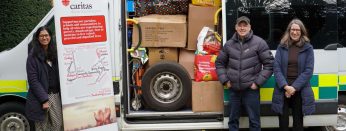

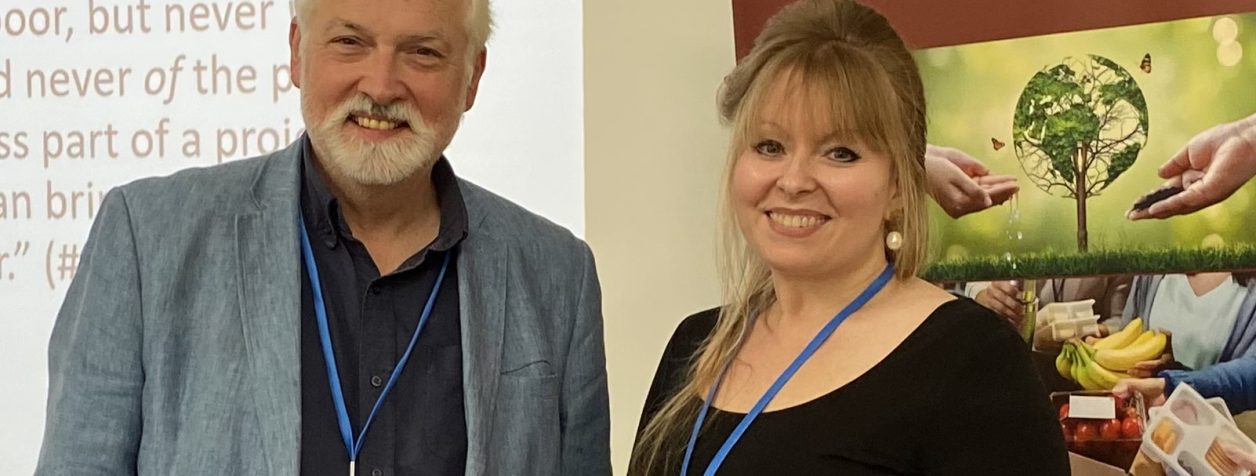
On Saturday 10 October, our CEO, Raymond Friel, was a keynote speaker at the inaugural conference of Caritas Cardiff Menevia, Called to Love, held at St Mary’s Catholic Church hall in Bridgend. The day was an opportunity to reflect in particular on Pope Leo’s exhortation, Dilexi te, and to meet other groups involved in social action in the area.
Raymond’s reflection provided some of the context of Dilex te, an exhortation begun by Pope Francis and brought to completion by Pope Leo, who has made it clear that Evangelii Gaudium, the first exhortation of Pope Francis, will be the road map for his pontificate. In that exhortation, Pope Francis was very clear about the responsibilities of Christians: “Each individual Christian and every community is called to be an instrument of God for the liberation and promotion of the poor, and for enabling them to be fully a part of society” (187).
Turning to Dilexi te, Raymond brought out some of the key challenges for the Catholic Church in England and Wales today, such as what a preferential option for the poor looks like in practice, what does it mean to challenge the structural causes of poverty and how bold should the Church be in raising a prophetic voice. Another topic which is exercising the Catholic community at the moment is the arrival of people in our countries seeking asylum. The Catholic community has not been immune to the far-right narratives of scapegoating and division. The teaching of the Church, inspired by the Gospel, is clear enough on this issue, as Pope Leo reminds us in Dilexi te:
“The Church, like a mother, accompanies those who are walking. Where the world sees threats, she sees children; where walls are built, she builds bridges. She knows that her proclamation of the Gospel is credible only when it is translated into gestures of closeness and welcome. And she knows that in every rejected migrant, it is Christ himself who knocks at the door of the community” (75).
Raymond concluded by encouraging the participants not to be afraid of being seen to be ‘political’. The Gospel is not party political, or partisan, but is political in as much as it is concerned with how we live together well in the ‘polis’, the human community. Pope Francis, in Laudato Si, puts it this way: “Love, overflowing with small gestures of mutual care, is also civic and political, and it makes itself felt in every action that seeks to build a better world” (231).
Raymond was followed by Dyleth Jewell, the Deputy Minister for Social Care, Mental Health and Women’s Health in the Welsh Government. Dyleth spoke passionately about her Valleys background and the strong sense of community which is still evident there despite the industrial policy of pit closures with little in the way of support or a just transition to other employment. She echoed much of the social doctrine of the Church by referring to the immense wealth the area generated for a small number of families, which men and woman paid for with their health and well-being. Dyleth referred often to her faith, to the gospels where we see Christ conveying dignity on people, especially the weakest.
In the afternoon, a series of workshops featured the SVP, St David’s Catholic College and Swansea City of Sanctuary, which gave some sense of the range of social action in Cardiff and Menevia. We were joined by Archbishop Mark O’Toole who was warm in his encouragement for the work of Caritas. He spoke with a clear understanding of the purpose of Caritas in a diocese, having been instrumental in setting up Caritas when he was the Bishop of Plymouth Diocese.