
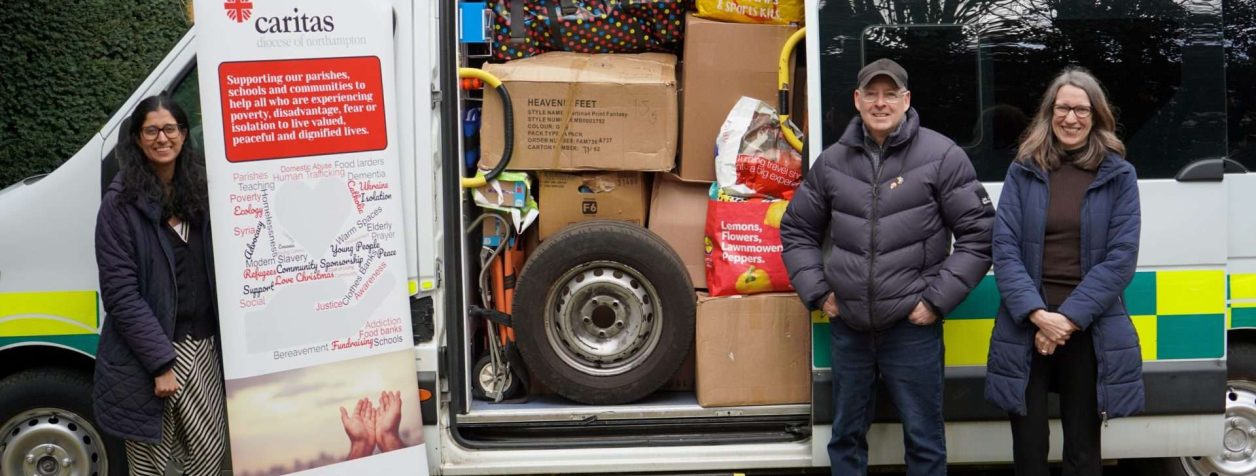
Loralie, Lead of Caritas for the Diocese of Northampton, speaks to CSAN’s David Byrne about how her career as a doctor has led to Catholic social action, why parishes matter, and what she learned from sitting on a plastic chair in a prison chapel.
DB: Why do you work in medicine and Catholic social action?
LR: When you go for a medical school interview at the age of 18, the standard, slightly clichéd answer is, ‘I want to do medicine because I care about people. I want to help people.’ That has been true of me since I was a child, I felt very strongly on behalf of others. I struggled as a child to watch TV adverts about famine and drought. And I remember from a very young age seeking out children in the playground who had no friends or were being bullied and making sure they were included. I wasn’t satisfied until I had taken action myself.
As the day-to-day nature of being a doctor has evolved administratively and with increasing demand, doctors have had less time with patients. The time we do have with patients must be very clear and concise; this is something I accept is important and necessary. I still work as a doctor every week, it continues to be a privilege and incredibly humbling. But personally, those calls to action I had as a schoolgirl never left me, I still want to give more to people.
Working in social action with Caritas gives me time to take my call to action to a deeper level; to talk to people and to discover what it means to be human through exploring, in depth, the root of social and individual isolation and deprivation. This has the potential for meaningful and lasting connection with the Church. It also gives me permission to speak about God, God’s love and dignity in theological terms. Caritas has allowed me to express something that was always within me. Perhaps I am still working out the full connection, but I know the two parts of my life belong together.
DB: What can medicine learn from Catholic Social Teaching (CST)?
LR: Medicine has made a real effort to stop being paternalistic. Sometimes patients are understandably frustrated when a doctor asks, ‘What do you think you could do to help?’ They reply, ‘I came to you because you’re the doctor.’ But I think the principle behind that move away from paternalism is an attempt at subsidiarity: decisions should be made as near as possible to the person they affect. The difficulty is that people who are unwell may not have the energy or resources to think through the problem for themselves and are looking for a top-down approach, looking for someone to solve it. The caring professions can then be placed in a kind of saviour role, instead of community, participation and relationships playing a larger role.
There are also profound questions about the dignity and value of human life. I hope medicine remains open to spiritual perspectives and recognises that these convictions are deeply held. Doctors do not all think alike, that’s absolutely normal, but people of all faith and none should be able to take part in honest, respectful and constructive dialogue on matters relating to the dignity of human life.
DB: What opportunities and challenges have you found in the Diocese of Northampton so far?
LR: It is a large diocese, covering Northamptonshire, Bedfordshire, Buckinghamshire and part of Berkshire. Like many dioceses, it includes affluent communities and areas of great poverty. Within the diocese are groups are even more remote from parish life, including people in isolation, in prison and people held in immigration detention.
When I came into the role, the first question was where to begin. The most useful opportunity was to build partnerships with great organisations that already exist. While it’s important for Caritas Northampton to have these relationships, the deeper task is to help parishioners understand that social action belongs to all of us. I am trying to help people understand the need in the first place, and importantly where Catholic Social Teaching informs our role as Catholics. When I visit a prison, an immigration detention centre, a food bank or another project, I try to bring what I have learned back to parishes and schools. That can generate interest, educate people, attract volunteers and, I hope, help new projects to begin in these areas of need.
The scale is a challenge. There are nearly 70 parishes, so one person cannot build every relationship alone. Caritas Northampton needs networks that connect people working in social action, justice and peace across the diocese and equip them to continue carrying the message into their own communities. Caritas Northampton sits within the Mission team, as mission has many faces and social action is one of them.
DB: Why do parishes matter so much for social action?
LR: Two years ago, at a Word on Fire conference, I heard Jenny Sinclair speak about Catholic Social Teaching in terms of civic and spiritual renewal. Suddenly I understood how my faith related to my work, my neighbourhood and my children. Jenny was not presenting something novel, but she explained it in a way that a lay parishioner like me could understand. I had never seen my faith as a weaving together of the everyday dimension of my life, and I knew then that I was not only being called to work in social action, but also that I wanted other people to discover what I had just discovered.
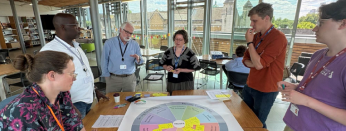
The parish is a round table where difficult realities can remain within everyone’s view. When I spoke in a church about prison ministry, I noticed children in the congregation and wondered whether I should change what I was going to say. But I didn’t amend anything, children know that prisons exist. They may go to their parents or teachers with difficult questions, but those questions are part of the reality we are called to face and not gloss over.
The parish also works at the level of relationship. A priest or bishop can say that an issue matters, and people may expect them to say it, they are the spiritual authority in church. But when the person who sits beside you at Mass explains why she volunteers in a prison every week, the issue becomes close and real. That witness can move social action from being one person’s concern to something a community shares. Subsidiarity and solidarity meet there.
DB: What did your first visit to a prison teach you?
LR: I’ll start by giving recognition, with great humility, to the priests, clergy, and parishioners who have served in prison ministry for years and decades. We should never take this for granted. At a chaplaincy retreat day, one of the prison chaplains said, ‘Just come along.’ I thought, ‘There is no “just come along” about this. Do you understand the undertaking?’ I was terrified, not of the people, but of my perception from TV of a hostile environment. I asked everybody I knew to pray for me.
When I arrived, it was time for Mass. The chaplain said, ‘Loralie, just sit in the middle of the men.’ Again, this felt like a very “normal” request to make of someone who was already frightened. But I sat down, and it simply felt like being in church. Two of the men chatted to me. At the sign of peace, everybody wanted to offer peace, while I was still overthinking what I ought to do.
I was sitting on a basic plastic chair in the prison chapel. Before this role, I had held a senior academic post in a medical school. In academic and medical life, there are clear ladders and hierarchies: you climb and you climb. Sitting in that chapel, I prayed, ‘God, what is this all about?’ The answer I felt was, ‘Of all the seats I want you to sit in right now, it is this one. It is this plastic chair in this prison chapel.’ All I wanted in this Caritas role was to be present and to relate, and at that moment I knew I was exactly where I was meant to be.
It showed me what Mass and Christian fellowship mean. The hymns are the same. The order of Mass is the same. The altar is the same. The Eucharist is the same. Perhaps Mass is the only place on earth where people equally receive exactly the same. Football stadiums have tiers and theatres have more expensive seats, but at Mass you do not receive more because you are a king or less because you are in prison.
The prison taught me that our Mass is their Mass, and their Mass is our Mass. We are not as different as we imagine, and people in prison are not somewhere outside our diocesan family. They are with us. That is what I now try to communicate to parishioners who have never been to a prison, as I imagine my story is not uncommon.
DB: How are you involving young adults and schools in this work?
LR: There is a renewed and exciting energy among young adults. The instinct for social action often does not need much explanation; the question is how to put it into practice. At the same time, young people are very time-poor. The cost of living means that people have to work increasingly longer and more unsociable hours, and many cannot promise the same hours every week to volunteer. This does not help the high rates of loneliness in young adults, so I am planning projects which meet both the goals of outreach, and valuing gathering and community so that social action can be relational at multiple levels.
I am therefore looking for opportunities with a clear, manageable commitment: perhaps a one-off request or something that can be done occasionally. There are Young Adult groups in the diocese looking for somewhere to ‘take’ their prayer groups. Prison and immigration-detention visits, or administration such as writing Christmas cards to isolated or lonely people or lobbying to MPs can offer some of those openings. Young adults are also close in age to many of the people in those settings. Men in prison have said to me, ‘Now we know somebody cares. We know the Church cares.’ What message of hope might it give them to see a person their own age choosing to be there simply because they care?
I have been so moved and impressed with the heart and energy from schools, some of whom have their own Mission or SVP groups. I am exploring, hands-on projects for children and young people, for example one school is creating prayer cards for a tree in a detention centre. It is a pro-active way for them to reflect on larger questions, while also knowing they are doing God’s work by loving their neighbour.
DB: Where do you hope to focus Caritas Northampton’s work next?
LR: Primarily I am looking to develop stronger social action threads between Caritas, parishes, schools and partners such as SVP, switching the lens from donation and giver to receiver, to relation between brother and sister, I have worked with some parishes to strengthen outreach projects they already have in place by involving schools or SVP; one project done well has a stronger likelihood of our brothers and sisters in need of God’s love having an ongoing relationship with the Church. I would like to deepen our relationships with organisations across the diocese and ask where we can serve, while confidently carrying a Catholic identity.
Supporting the people who already support others feels like an important direction. Another cross-over from my medical role is an understanding of ‘pouring from an empty jug’, and the risk of burnout amongst people who are giving so much empathy and compassion to others. I am also thinking about people who become invisible because they are grouped together as the working population. They may have accommodation and food on the table, but they may be doing unseen work in poor conditions or struggling despite having one or more jobs. The dignity of work and in-work poverty matter here. The preferential option for the poor should also make us ask whether there are forms of poverty we are simply failing to notice.
DB: What would you like Caritas to help rebuild in our communities?
LR: We have lost many of the commons: the local places where people meet, form friendships, sit around a table and discuss what matters. I would love Caritas Northampton to help create some of those spaces again, not through another board meeting or a strategy exercise, but through the very basic act of gathering. It could be as simple as a young-adults’ evening once a quarter where people come together and talk, without arriving with an action plan.
Sometimes our part is simply to make the space, send the invitations and build the friendship. We should not rely only on ourselves; we have the Holy Spirit. The prayer often attributed to St Oscar Romero is a helpful reminder that we may only be planting seeds. We may not be the people who water them or see them grow. We can be content to play our part. That is enough for God, and it should be enough for us, his grace is sufficient after all.
Loralie is Lead of Caritas for the Diocese of Northampton.
Learn more about the work of Caritas Northampton here.