

It’s been fascinating to observe some of the media coverage of Pope Leo XIV’s first encyclical. Many Catholics seem to be just as (if not more) interested in what the world has to say about the Pope than what the Pope has to say to the world.
This isn’t necessarily a critique. Since he first appeared on the balcony of St. Peter’s Basilica, Pope Leo’s first words already echoed far beyond the walls of the Vatican City. I remember that moment with fondness. I was walking through Belfast on a hot, sunny day with an iced americano in one hand and the live television coverage of the papal election in the other. I will never forget when the newly elected Bishop of Rome first appeared on the balcony and addressed the world with those beautiful words: “Peace be with you all!”
How we needed to hear those words then, and even more how we need to hear those words now. As Pope, Leo can rightly be described as the world’s pastor. I suspect he wouldn’t object to this title. At Vatican II (and in the lead-up to it) the Church undertook a radical reorientation. For centuries it had been used to looking up at God, looking inwards at itself, and looking down upon its members. Following the reforms of that great council, the Church strove to maintain its upward gaze at God, but complemented it with a more humble and searching look at itself and the world.
The result was a Church which increasingly looked outwards at the world, and invited the world to look at it in turn. We might even speak of a kind of eye-contact between the Church and the world beginning to emerge in the decades following the council.
In this context, the Pope began to address his pastoral letters not merely to the Catholic faithful, but (with an increasing awareness of the porous and invisible boundaries of the Church) to all of humanity. In turn, the world has responded to this address with an increased attention to the activity of the Church – for better or for worse.
The Church has had many titles by which to describe itself over the years. Whichever of these she has stressed at one time or another, certain descriptors have both a perennial value as well as a particular historical significance.
Our present moment is best described as a global polycrisis. I won’t list the many interlocking issues which contribute to the complex series of crises that we face in 2026, but you will be familiar with them all. With such an overwhelming sense of things gone awry, it is helpful therefore to have our attention directed to address one in particular by Pope Leo in his first encyclical.
Titled “Magnificent Humanity”, it describes its aim as “safeguarding the human person in the time of artificial intelligence.” What I find most striking in this subtitle is not the focus on AI – the technology of the moment. Rather, it’s the way Pope Leo is drawing our attention to what is most affected by its ever-accelerating emergence – the human person. As often, the Church reorients our gaze towards what is easily forgotten or overlooked.
This theme continues as the encyclical turns its focus to “the value of work”. Drawing upon the Father of Western Monasticism, Benedict of Nursia, Pope Leo appears to lament the radical severance between work and prayer that characterises much of contemporary employment. Instead, Leo describes how our nature as bearers of the imago Dei means that when we work we have the opportunity to co-participate in the original creative work of God (148).
Moreover, Leo stresses that “work is not simply an instrument” as it so often seems to be in the modern technocratic world (149). Many people today undertake work that serves profit before people. This is a dehumanising and degrading experience that is not dissimilar to a kind of slavery. Instead, Pope Leo asserts work as the ordinary “path towards maturity, development and personal fulfilment” (149) implying that it is first and foremost an enterprise we undertake for the existential development of ourselves and for others, rather than for the advancement of some abstract financial end.
Consequently, work is more than a postlapsarian punishment. It is part of the means by which we live out and experience our dignity as bearers of the image and likeness of the Trinity. An important corollary of this is that the denial of meaningful opportunities to secure proper work is at the same time a blockade on the development of the person and an affront to their dignity. Whilst noting the importance of “financial assistance to the poor” (which can quickly become paternalistic or tokenistic) the Pope has a more ambitious vision, “since the goal of each person is to live with dignity through his or her own work.” (149).
I think it is important to linger here on this short sentence. Pope Leo is here sketching some of the contours of a theological anthropology, a vision of what it is to be human in relation to God. What I find fascinating is the radically inclusive scope of the Pope’s words. It is not the goal of those who are somehow deemed “capable” of work to live with dignity in this way. No, it is the goal of “each person” – all of us! Without explicit reference to the systems of capital and commerce that define the technocratic economies of the West, the Pope is nevertheless calling for a reconfiguration of the nature of work so that opportunities for meaningful work are afforded to all people.
To realise this vision, the world will have to think carefully about some of the other principles of Catholic Social Thought and Practice – especially the preferential option for the poor. While monetary assistance is necessary for those who are suffering from the affliction of poverty, it is insufficient. The more difficult task is to think radically about the ways that workplaces are currently excluding the poor, the disabled and others who are presently being told that in various ways: “work is not for you.” This is an insufficient answer.
The social model for disability is one school of thought which has led to fruitful and concrete transformations in the environment to ensure those living with a disability have equal access to resources and opportunities in the world as those with able bodies and minds. Pope Leo is calling us to an approach just as radical in relation to work. It will not suffice to tell anyone that there is not some sort of work which we need them to do for the building of God’s Kingdom on earth. To fully realise this vision will require a serious reconsideration of the nature of work and how people can participate in it. But the challenge is there.
We in the charity sector should be leading lights when it comes to offering innovative, novel and flexible opportunities for work which includes those presently excluded from the working world. As Pope Leo has highlighted, our work is a form of prayer, and a means of experiencing union with God in acts of participatory co-creation. The crisis of employment is therefore also a crisis of human dignity and the ability for persons to actualise and experience it.
As always, encyclicals like this are incredibly fruitful sources for reflection. I produced this brief feature on the basis of just a few paragraphs from Leo’s first letter. I look forward to reading more over the coming weeks and months. Please do share your reflections with me and the team. We would love to hear them, especially as we consider how they shape our understanding of the dignity of work, but also the priorities of the wider CSAN network.
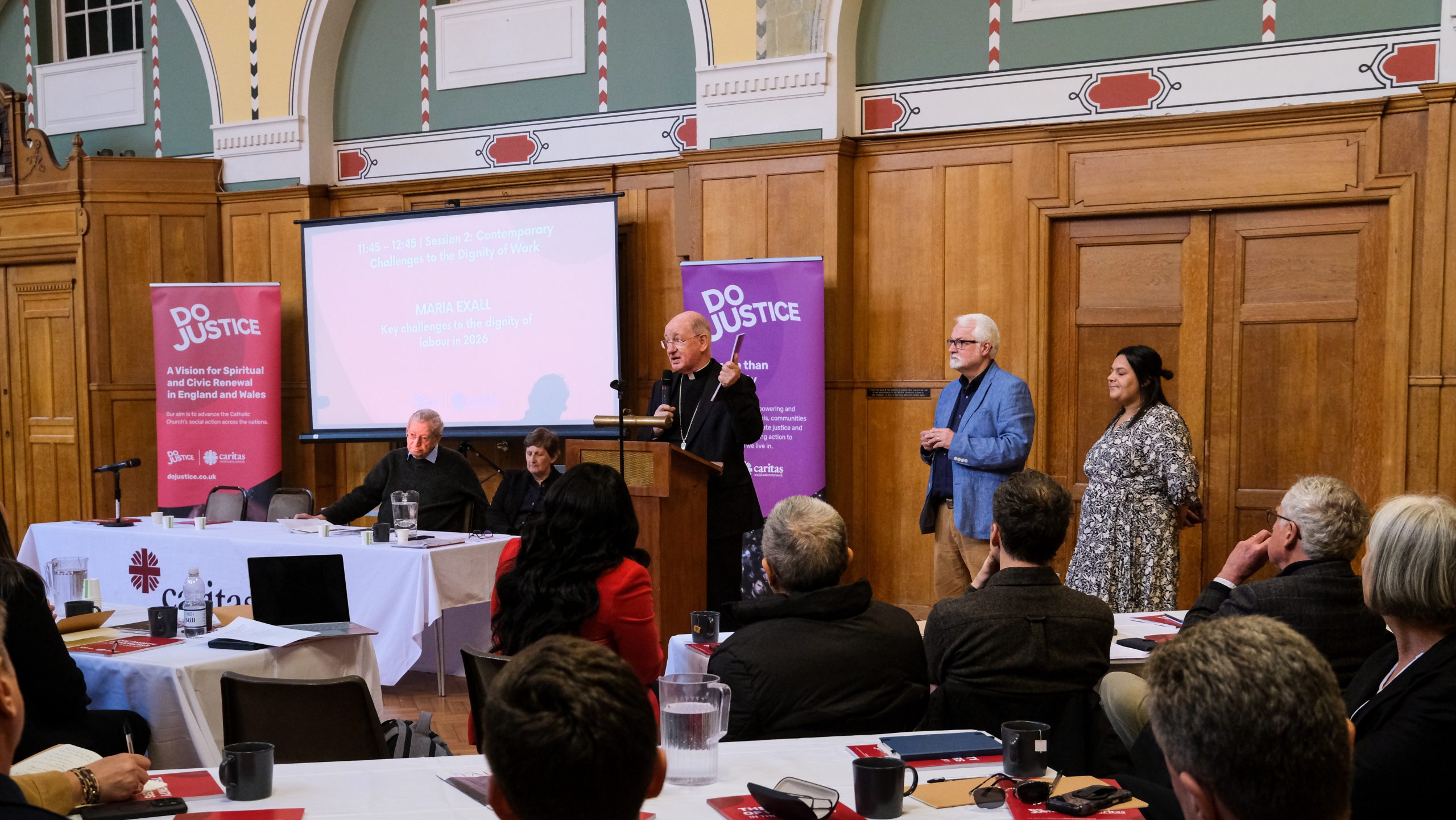
This article was written by CSAN’s Communications and Programmes Officer, David Byrne, reflecting on Pope Leo XIV’s first encyclical, Magnifica Humanitas, and its implications for Catholic Social Thought, the dignity of work, and the mission of the Caritas network.